![A white drone faces the camera, displaying the text 'DJI' in green on its front upper body. It features four arms with rotors, landing legs, and a camera mounted underneath.](.coms-address-ttm-and-scalability-challenges/fc1b2045d88b1a43a672c0a8d37fdefab9066e8ea2c74ea28d64bc3801d94942.jpg)

# Computer-on-Modules Address Time-to-Market and Scalability Challenges for Next-Gen Drone Startups

Abstract: The ADLINK Technology COM portfolio empowers drone startups with scalable, straightforward designs that accelerate time-to-market and AI performance for cutting-edge drone platforms

The international drone market has been on the rise in recent years, with emerging AI technology, evolving high-performance edge computing (HPEC) platforms, and a surge in global conflicts driving rapid growth. Startup and scale-up drone technology companies especially have thrived in this opportunistic new environment where consumer and commercial drones are now being produced by the thousands each day.

Where there is opportunity, there is competition, and competition breeds innovation. To get to market quickly with best-in-class drone platforms—often in less than a year—these startups and scale-ups are now turning to embedded technology companies experienced in modular design principles to gain a competitive edge.

# Technology & Talent Driving Drone Innovation

With manufacturing costs falling, widespread production of drone components, and the introduction of open-source flight software like ArduPilot and PX4, drone development is now an accessible field that addresses a wide range of markets. Meanwhile, safety and regulatory innovations such as geofencing, remote ID and anti-collision systems ensure safe, reliable operation as the market continues to grow.

While the drone market is currently enjoying commercial success, many of the technologies propagating its growth were commercially hardened in adjacent markets. Innovation in drone subsystems like communications (telecom and Industrial IoT), advanced sensors (automotive safety), and power supplies (electric vehicle and consumer batteries) has largely been transplanted from other industries (Figure 1). The same is true of the AI technology.

![The image displays a digital icon on a solid blue background. It features a white isometric outline of a box at the bottom center. Directly above the box is a white arrow pointing downward, with its tip just touching the top edge of the box. Both the box and the arrow are enclosed within a hexagonal shape formed by white dashed lines.](.coms-address-ttm-and-scalability-challenges/2606df7bce2a30eb3ba9ad0536d8fb4f9e88b887b8f14c818b5d836bd802be30.jpg)

![The image displays a white line drawing on a solid blue background. The graphic consists of a lightning bolt positioned directly above a stylized leaf, which is formed by two curved shapes resembling sprouting leaves. There is no text present in the image.](.coms-address-ttm-and-scalability-challenges/5acc03729d98176ce4e043db94ea7a51291e014a29e3be1ffd24e2ad53c8398b.jpg)

# Domain: Component miniaturization

• Sensing & Navigation (smaller, lighter sensors)
• FCU/Compute (denser boards)
• Airframe (smaller fuselages)

Innovations: HD/rigid-Flex PCBs; MEMS IMUs; micro-LiDAR & compact GNSS; small form factor COM/SoMs

Significance: Longer flight time from lower mass; denser features per gram; cheaper mass market sensors; more payload headroom

Adjacency: Smartphones/consumer electronics; PCB manufacturing; automotive MEMS

# Domain: Energy efficiency

• Propulsion (higher motor+prop efficiency)
• FCU/AI (lower compute watts)

Innovations: High-efficiency BLDC motors/ ESCs; optimized aero-props; low-power MCUs/ NPUs; dynamic power management

Significance: Extra minutes of endurance; reduced thermal load; smaller batteries for same mission → lower cost

Adjacency: Aerospace UAV propulsion; mobile/ edge silicon efficiency R&D

![The image displays a white icon on a blue background. The icon features a battery outline with three vertical bars inside, representing the battery cells or charge level. Overlapping the top left portion of the battery is a circle containing a lightning bolt symbol.](.coms-address-ttm-and-scalability-challenges/19b62f8c5edd0d6d555a40c7a469ed72addd565eac85bfa213a6b1d724fe0b5f.jpg)

# Domain: Power supply technologies

• Power Supply (energy source & regulation)
• Propulsion (longer endurance)

Innovations: Higher-W/kg Li-ion/Li-Po packs; smart BMS; hydrogen fuel cell stacks; hybrid gensets

Significance: Extended range/time-on-station; lower \$/km; resilience in cold/heat with smarter BMS

Adjacency: EV & consumer-battery supply chain; aerospace fuel-cell programs

![The image features a white icon set against a solid blue background. The central graphic is a stylized representation of a dome security camera. Flanking the camera on both the left and right sides are three concentric arcs on each side, resembling wireless signal waves. Directly below the camera's base are two additional concentric arcs. There is no text in the image.](.coms-address-ttm-and-scalability-challenges/ba710ac55443d04306d493cb2bc7354585b9294c4b3d2b6711eb53ad308c2761.jpg)

# Domain: Sensing capabilities

• Sensing & Payloads (higher fidelity perception)
• AI/Perception (better data for detection/ SLAM)

Innovations: UHD global-shutter cameras; mini LiDAR; multispectral/thermal cores; sensor fusion stacks

Significance: Higher mapping precision; safer navigation; new agri/inspection use-cases; fewer repeat sorties

Adjacency: Automotive ADAS; smartphone imaging; robotics & remote-sensing

![The image displays a white icon on a solid light blue background. The icon represents a stylized microchip or processor, featuring a central square with four protruding rectangular shapes extending from the top, bottom, left, and right sides. Inside the central square, the letters 'AI' are written in a white sans-serif font.](.coms-address-ttm-and-scalability-challenges/c2b1ad89757892e00332e79bfea91edb76bf90c4e616c086d750d48fe1da1cd5.jpg)

# Domain: Artificial intelligence (AI)

• AI/Perception & FCU (onboard autonomy, obstacle avoidance, multi-agent coordination)

Innovations: On-module NPUs; quantized CV models (e.g., YOLO variants); VIO/SLAM; neuromorphic/energy-aware inference

Significance: Easier ops; reduced operator workload; autonomous fleets; better mission success rate

Adjacency: Edge-AI/robotics; mobile SoC NPUs; academic CV/SLAM research

![A white vector icon depicting a quadcopter drone carrying a cardboard box, set against a solid blue background.](.coms-address-ttm-and-scalability-challenges/f71538f3629214580b9340be11cb21114e799016558b4accde0fd8e23f88b116.jpg)

# Domain: Drones as IoT devices

• Comms & Links; Ground/Cloud; Payload streaming

Innovations: 5G/Private-LTE backhaul; lowlatency codecs; cloud telemetry APIs; fleetmanagement stacks

Significance: Real-time HD/4K streaming; BVLOS enablement; faster analytics; lower OPEX via remote ops

Adjacency: Telecom (4G/5G); cloud/edge computing platforms; industrial IoT

Figure 1. Drone technology innovation borrows many capabilities from other industries. The presence of so many new and emerging technologies in alreadycomplex aerospace and drone designs can present significant challenges for startups and scale-ups entering the drone marketplace.

As such, much of the technical talent entering the drone market via startups or scale-up companies comes with core competencies in disciplines other than pure aerospace or drone design engineering.

And, despite the current low barriers to entry, consumer and commercial drones remain highly complex devices that rely on skilled integration of propulsion, flight control, communications, navigation, and ground control systems.

Any decent technologist knows that rapid market expansion; an influx of new and

inexperienced organizations; and demand for technology innovation at an accelerated pace is a formula for a sharp learning curve. For companies facing drone design and manufacturing challenges that

![Drone in flight with red and black components against a cloudy sky (no visible text or symbols)](.coms-address-ttm-and-scalability-challenges/bc254710c0a215ecb0c4d2b735d05f56558971d46eda84862d4610596219ba14.jpg)

they may not be prepared to take on, a computer-on-module (COM) approach offers reductions in design complexity, faster time to market, and potentially reduced costs while meeting all the technical requirements of stateof-the-art drones.

![The image displays a blurry, low-resolution quadcopter drone hovering against a plain white background. The drone features a central red body with four black arms extending horizontally, each terminating in a motor and a spinning propeller. A black structure, likely landing gear or a camera mount, hangs beneath the central body. There is no text visible in the image.](.coms-address-ttm-and-scalability-challenges/b813a73a4c5b03fc04873b47d5ee231f6974cf165207f5462646a8bc97f36bcd.jpg)

# Streamlining Drone Design with COM

Most drone startups lack the full spectrum of expertise required to bring products to market quickly. This means they need proven, scalable solutions that offload time-intensive design tasks while still delivering high performance across different form factors and other industries by using COMs built on open standards such as SMARC, OSM, or COM-HPC Mini. These modules offer easy interchangeability, long-term availability, and scalable performance options. Already produced en masse, off-the-shelf COM modules

price ranges. Support for edge AI processing used in mapping, obstacle detection, and object recognition is particularly important for modern drones—as is energy efficiency, streamlined thermal management, and easy remote manageability that extends platform lifecycles.

A highly effective way to meet these demands is by building designs around COMs, which deliver a robust and scalable hardware architecture for drone development. COM architectures have been deployed with great success in many emerging application spaces, including surgical robots, intelligent retail kiosks, and battlespace communications systems, to name a few.

Drone manufacturers gain similar advantages as counterparts in

# Leveraging the Scalability of COMs

In today’s market, drones come in many shapes, sizes, and capability levels, with equally diverse computing requirements. ADLINK offers a wide range of COM standards to meet market demand, providing many form factors and performance options to suit specific builds:

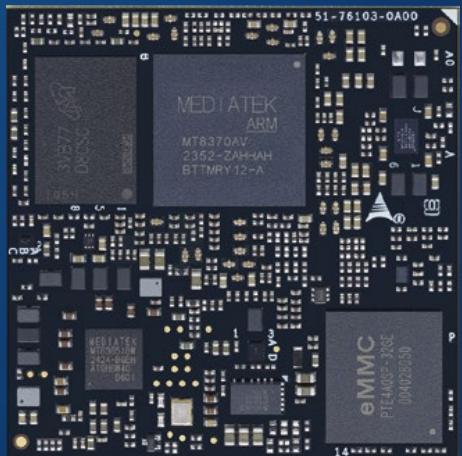
Ideal for ultra-compact drone platforms, SMARC and OSM-based solutions like the OSM-MTK510 module balance high performance with minimal size and weight.
When next-level processing is required, ADLINK’s COM-HPC-mMTL COM-HPC Mini module delivers up to 16 CPU cores and 8 GPU cores in a 95 x 70 mm footprint to support real-time processing, AI inference, and high-speed communication.

ADLINK’s recommended SKUs for drone applications include (Sidebar 1, Table 1):

shorten time-to-market. Pairing these modules with an off-theshelf or custom-designed common carrier board (a companion PCB dedicated to providing applicationspecific I/O interfaces) allows drone manufacturers to use the same hardware platform across different COM models and generations as the market evolves.

SMARC, OSM, and COM-HPC Mini also offer energy-efficient Arm processors that are ideal for flight control and image processing tasks. With low thermal design power (TDP), Arm-based COMs greatly simplify thermal management and reduce weight by eliminating associated heat sinks. Moreover, these COM standards typically feature advanced interfaces to support modern multi-camera drones.

![This image displays a close-up, angled view of a blue-toned electronic circuit board, likely a computer motherboard or logic board. The board features a complex network of circuit traces and is populated with four prominent square integrated circuits (chips). Two chips are located in the upper left section, and two larger chips are positioned in the lower right section. Scattered across the board, particularly in the center and lower left, are numerous smaller surface-mounted components such as capacitors and resistors. The image has a grainy quality and is dominated by deep blue and purple hues.](.coms-address-ttm-and-scalability-challenges/6de1735f2c813fa9fba5a526603da416fc54010a6d2b8c3e76d4faf27ef8faec.jpg)
OSM-MTK510

![This image displays a blue printed circuit board (PCB) with various electronic components.  **Visual Elements:** *   **Mounting Holes:** There are four circular mounting holes with gold-colored rings at the corners of the board. *   **Connectors:** On the left edge, there is a white rectangular connector (likely USB or Ethernet). Along the right edge, there is a row of gold header pins. *   **Integrated Circuits (ICs):** In the center, four large black square chips are arranged in a 2x2 grid. Below the white connector on the left, there is another black square chip. *   **Passive Components:** Various small black and silver surface-mount components (resistors, capacitors) are scattered throughout the board. *   **Text:**     *   Near the top right edge, small white text reads 'REV 1.1'.     *   Along the bottom edge, white text reads 'Raspberry Pi 2 Model B'.](.coms-address-ttm-and-scalability-challenges/55d2e758e0feb0f75f6ec04e8e31b8c9b9ab23f3c00120c820c64989eab8aa59.jpg)
LEC-MTK-i1200

![The image displays a blue printed circuit board (PCB). At the top edge, there is a row of white rectangular pads. On the left side, a white rectangular connector housing is visible. In the center, two large, dark square integrated circuits are prominent. Surrounding these main chips are numerous smaller electronic components, including smaller chips, resistors, and capacitors. Four mounting holes with white rings are located at the corners. There is no legible text visible on the board.](.coms-address-ttm-and-scalability-challenges/ecc555d9705769eb71a7ce722c608dd4acf6e1960f5c3304a26e7da80fc01553.jpg)
LEC-RB5N

![The image displays a blue printed circuit board (PCB) populated with electronic components. A large square microchip is centrally located, surrounded by smaller black integrated circuits, resistors, and capacitors. To the left is a rectangular connector, likely USB, and rows of gold-plated pin headers run along the top and bottom edges. Four circular mounting holes with white centers are situated at the corners. Near the bottom right edge, the white text 'WILYAN' is printed on the board.](.coms-address-ttm-and-scalability-challenges/1dae8d45ad975686479efa1028eff887ed49f618c4bcd7953231e473243ae40f.jpg)
LEC-IMX95

![Close-up of a microprocessor board with visible circuitry and gold contacts (no text or symbols)](.coms-address-ttm-and-scalability-challenges/2a99443263d3ca7b054fd31eaee326adbdc365c9fae31cdcb5f7f8aaf8641f6b.jpg)

COM-HPC-mMTL

<table><tr><td>COM / Module (SoC)</td><td>CPU / SoC &amp; AI capability</td><td>Size &amp; power</td><td>Approx. price (dev kit)</td><td>Suitable drone types &amp; example use cases</td></tr><tr><td>OSM-MTK510(MediaTek Genio 510)</td><td>Hexa-core (2×Cortex-A78 + 4×A55) SoC with Mali-G57 GPU &amp; up to 3.2 TOPS AI accelerator; supports up to 8 GB LPDDR4 &amp; 128 GB eMMC</td><td>45 × 45 mm OSM-Size-L; 5 V supply; power consumption under 5 W</td><td>Dev-kit pricing not yet public</td><td>Micro/U-compact UAVs – Small drones needing lightweight imaging, basic AI inference &amp; low-power remote-control units</td></tr><tr><td>LEC-MTK-i1200(MediaTek Genio 1200)</td><td>Octa-core (4×Cortex-A78 + 4×A55) SoC with Mali-G57 GPU &amp; up to 5 TOPS NPU; designed for robotics &amp; drone AIoT applications</td><td>82 × 50 mm SMARC-2.1 module; 5 V input &amp; &lt;8 W typical power consumption</td><td>US $399</td><td>Mid-range drones – Mid-range UAVs requiring computer vision, multi-camera support &amp; mid-level autonomy (mapping, obstacle avoidance)</td></tr><tr><td>LEC-RB5N(Qualcomm QRB5165)</td><td>Octa-core Kryo 585 CPU with Adreno 650 GPU &amp; AI engine delivering up to 15 TOPS; supports up to six cameras &amp; low-power operation</td><td>82 × 50 mm SMARC; 5 V DC supply; power consumption &lt;12 W</td><td>US $499</td><td>High-end consumer &amp; industrial drones – Advanced AI and multi-camera vision, object recognition &amp; obstacle avoidance for consumer, enterprise, defense &amp; logistics drones</td></tr><tr><td>LEC-IMX95(NXP i.MX 95)</td><td>Up to 6x Cortex-A55 CPUs plus real-time -M7 &amp; -M33 security cores with Mali-G310 GPU &amp; up to 2 TOPS NPU; supports up to 8 GB LPDDR5</td><td>82 × 50 mm SMARC; 5 V input; &lt;6 W typical power consumption (estimated)</td><td>US $399</td><td>Enterprise &amp; industrial drones – Reliable control systems, secure connectivity, TSN-capable Ethernet; suitable for sensor-fusion, data-processing &amp; industrial inspection</td></tr><tr><td>COM-HPC-mMTL(Intel Core Ultra)</td><td>Intel “Meteor Lake” Core Ultra processors up to 16 cores with Intel Arc graphics (up to 8 Xe cores) and an AI Boost NPU delivering up to 8.2 TOPS; supports up to 64 GB LPDDR5x, and optional NVMe SSD storage.</td><td>95 × 70 mm COM-HPC Mini; U-series SKUs ~15 W TDP; H-series SKUs up to 28 W</td><td>US $799</td><td>Large/heavy-lift drones – High-performance edge-AI, real-time SLAM &amp; high-resolution imaging; ideal for complex autonomous missions, heavy-payload logistics &amp; demanding compute workloads</td></tr></table>

# ADLINK COMs Boost AI Workload Performance in Next-Gen Drones

To support advanced autonomy for increased effectiveness, modern drones rely on AI functions such as object recognition, obstacle avoidance and environmental monitoring, which currently achieve accuracies of up to 94%. Deep learning models like YOLO and Faster R-CNN enable these real-time AI tasks, enhancing navigation and flight path planning in complex environments.

Depending on the workload, these functions can execute on realtime microcontrollers for stabilization or obstacle avoidance, but more powerful Linux-based microprocessors are used for video streaming, battery management, or route planning tasks (Table 1). In all cases, power-optimized CPUs are crucial for maximizing flight time.

<table><tr><td>AI function-model</td><td>Accuracy / latency / memory</td><td>Recommended ADLINK COM module &amp; rationale</td><td>Optimal OS &amp; framework</td></tr><tr><td>Object detection-YOLOv8-n (ultra-light)</td><td>Accuracy: mAP = 0.30-0.35Latency: ~16 ms/frameMemory: 6-8 MB (INT8 quantization)</td><td>LEC-IMX8MP (SMARC) - Uses NXP i.MX 8M Plus with optional 2.3 TOPS NPU and quad Cortex-A53 cores, offering low-power AI inference and dual CAN/USB interfaces-well-suited for light detectors on small drones</td><td>OS: Yocto or Ubuntu (custom build)Frameworks: TensorFlow Lite, ONNX Runtime or Arm NN for the NPU; PyTorch→ONNX for CPU fallback</td></tr><tr><td>Object detection-YOLOv8-s (balanced)</td><td>Accuracy: mAP = ~0.40-0.45Latency = ~8-15 ms/frameMemory: 20-30 MB (INT8 quantization)</td><td>LEC-MTK-I1200 (SMARC) - MediaTek Genio 1200 SoC (4x Cortex-A78, 4x A55) with integrated APU delivering up to 5 TOPS, supports up to three cameras and low-power operation-ideal for mid-range detection and segmentation workloads</td><td>OS: Yocto Linux or AndroidFrameworks: TensorFlow Lite (via MediaTek NeuroPilot), ONNX Runtime, or TFLite-Delegate for the APU</td></tr><tr><td>Object detection-YOLOv8-m &amp; instance/semantic segmentation</td><td>Accuracy: mAP = ~0.44Latency: ~20-50 ms/frameMemory: 40-50 MB (INT8 quantization)</td><td>COM-HPC-cRLS (Client) - 13th generation Intel Core module with up to 24 cores/32 threads, 128 GB DDR5, and 16 PCIe Gen5 + 8 Gen4 lanes; Provides AVX2 VNNI instructions and Intel UHD graphics for AI acceleration; suits heavier detectors and segmentation models</td><td>OS: Ubuntu 20.04/22.04Frameworks: PyTorch→ONNX→TensorRT, OpenVINO, or ONNX Runtime for x86; also supports Docker for containerized pipelines</td></tr><tr><td>Multi-object tracking-ByteTrack</td><td>HOTA = ~63.1Latency: Adds 1-2 ms per frame</td><td>COM-HPC-cRLS (Client) - The high-performance CPU/GPU and PCIe Gen 5 lanes accommodate multi-camera and sensor fusion workloads</td><td>OS: UbuntuFrameworks: ByteTrack C++/PyTorch compiled with OpenCV on top of TensorRT or OpenVINO</td></tr><tr><td>Semantic segmentation-BiSeNetFormer</td><td>Accuracy: mIoU = ~0.40-0.50Latency: 35-38 FPSMemory: 4-5 MB (INT8 quantization)</td><td>Express-ADP (COM Express Type 6) - 12th generation Intel Core module with up to 14 cores (6 P-cores + 8 E-cores), Intel AVX-512 VNNI/DL Boost, DDR5 up to 4800 MT/s, and 16 PCIe Gen 4 lanes; integrated Iris Xe GPU (up to 96 EUs) accelerates segmentation and depth models</td><td>OS: Ubuntu 20.04;Frameworks: OpenVINO (leverages AVX-512 and DL Boost), TensorRT via ONNX conversion, or PyTorch→ONNX Runtime</td></tr><tr><td>Depth estimation-MiDaS (tiny)</td><td>Accuracy: WHDR = 0.15Latency: ~8 FPS on Jetson NanoMemory: 20 MB (INT8 quantization)</td><td>LEC-MTK-i1200 - The Genio 1200&#x27;s 5 TOPS APU and multiple CSI interfaces handle real-time depth estimation from single/multiple cameras</td><td>OS: YoctoFrameworks: TensorFlow Lite (via MediaTek APU delegate) or ONNX Runtime; fallback to PyTorch on CPU if needed</td></tr><tr><td>Optical flow / obstacle avoidance - EdgeFlowNet</td><td>Accuracy: &gt;20% accuracy improvementLatency: 100 FPS at 1.08 W</td><td>LEC-IMX8MP - The i.MX 8M Plus with integrated NPU (~2.3 TOPS) runs compact CNNs like EdgeFlowNet efficiently; low power draw suits tiny drones</td><td>OS: Yocto or RTOS layer on top of LinuxFrameworks: TensorFlow Lite with NPU delegate, OpenCV-DNN for CPU fallback</td></tr><tr><td>Object classification / environmental monitoring - EfficientNet-B0</td><td>Accuracy: Top-1=~77.1%Latency: 2-5 msMemory: ~5-7 MB (INT8 quantization)</td><td>LEC-IMX8MP - Low-power Arm cores and NPU suit lightweight classification; video interfaces (LVDS/ DSI/HDMI) support display or downstream processing</td><td>OS: Yocto or UbuntuFrameworks: TensorFlow Lite (quantized), PyTorch→ONNX Runtime.</td></tr><tr><td>Visual-Inertial Odometry / navigation - Navion or similar VIO</td><td>Accuracy: Trajectory error ~0.28 % (Navion)Latency: Real-time at 20 FPS</td><td>Express-ADP - The hybrid CPU and Iris Xe GPU enable sensor fusion and VIO algorithms; PCIe Gen 4 lanes allow integration of dedicated accelerators</td><td>OS: Ubuntu (real-time kernel) or YoctoFrameworks: ROS 2 with VIO libraries, OpenVINO for vision layers, FastDDS or DDS for inter-process communication</td></tr><tr><td>Flight path planning / high-speed navigation - RL policy</td><td>Accuracy: Success 100% up to 5 m/s; 60% at 10 m/sLatency: ~39 ms</td><td>COM-HPC-cRLS - High core count Intel CPU and DDR5 memory deliver the compute headroom needed for reinforcement learning planners and real-time control</td><td>OS: Ubuntu with CUDA/cuDNN (if using a discrete GPU) or OpenVINO for CPU-bound inferenceFrameworks: PyTorch→ONNX→TensorRT, RLlib, or Stable Baselines</td></tr><tr><td>RL navigation / safe flight - Deep-PPO</td><td>Latency: 1-60 msMemory: ~150k params-FP32 0.6 MB; FP16 0.3 MB; INT8 0.15 MB; Activations ~3-6 MBMemory: 1.1 MB INT8 weights</td><td>Express-ADP - Provides sufficient compute and AI acceleration (AVX-512 VNNI) for training or inferencing RL navigation policies in mid-range UAVs</td><td>OS: UbuntuFrameworks: PyTorch or TensorFlow for RL training, ONNX Runtime for deployment</td></tr></table>

Table 1. There are a variety of AI models available to drone developers that can be paired with open-source AI development frameworks and off-the-shelf COM modules to efficiently develop advanced drone projects.

# How To Use This Directory

The following guidelines help dronemakers select the right combination of AI model, operating system, development framework, and ADLINK COM.

# Identify mission and compute budget—The “Accuracy/ latency/memory” column describes resource requirements for a variety of AI modelsa

• Lightweight tasks like YOLOv8-n, EdgeFlowNet, and EfficientNet‑B0 target small drones
Heavy tasks such as YOLOv8-m, segmentation, and RL planners require more powerful COM modules
![Woman operating a drone in an open, barren landscape with power lines and distant buildings (no visible text or symbols)](.coms-address-ttm-and-scalability-challenges/680c16be08514280b4f4e9029066eb75874de8eb532cf7a9938fa0882422f80a.jpg)

# 3 Match software stack—The operating system and framework column recommends standard development environments:

Yocto or Ubuntu for Arm-based modules (LEC‑IMX8MP, LEC‑MTK‑I1200)
• Ubuntu (often with a real‑time kernel) for x86 modules (Express-ADP, COM-HPC-cRLS)
Depending on hardware capabilities, frameworks like TensorFlow Lite, ONNX Runtime, TensorRT, OpenVINO, PyTorch, and ROS 2 may be recommended; always convert and quantize models (INT8/FP16) to meet latency targets
![Delivery drone in flight over a modern house with a palm tree in the foreground (no visible text or symbols)](.coms-address-ttm-and-scalability-challenges/9c9b6c543899d6f97f69b88f71b429dffcd3841034141e32abee6a1cad7fdfdd.jpg)

![Technician in safety gear operating a drone over water with power transmission tower in background (no text or symbols visible)](.coms-address-ttm-and-scalability-challenges/945e123b7ef23721e38e90ab5817021d803abba97cafe394e4094c90800a8518.jpg)

# 2 Choose an ADLINK computer-on-module—ADLINK modules that suit drone applications and are available offthe-shelf can be found in the third column:

LEC-IMX8MP for ultra-low-power inference with an optional NPU
LEC‑MTK‑i1200 for balanced performance and multiple camera inputs
Express‑ADP for mid‑range x86 compute with AVX‑512 and Iris Xe
COM-HPC-cRLS for high-end workloads needing many cores, DDR5 memory, and PCIe Gen 5 bandwidth
![Close-up of a quadcopter drone in flight against a blurred snowy landscape background (no text or symbols visible)](.coms-address-ttm-and-scalability-challenges/4244779a824dc921fc16d8b035aecf7cf67411d4239daad05f39c89b43e41809.jpg)

# 4 Consider peripherals—Modules differ in available camera interfaces, Ethernet ports, and PCIe lanes (for multi-camera or sensor fusion systems, modules with more PCIe lanes (e.g., COM-HPC-cRLS or Express-ADP) ensure the OS provides appropriate driver support).

# 5 Benchmark and calibrate. Performance figures are typical models on your data and calibrate INT8/FP16 quantization to achieve the best balance of accuracy and efficiency.

The ADLINK SMARC LEC-RB5N module is a prime example of how to increase drone performance using a Linux microprocessor-based COM. This solution is based on the Qualcomm QRB5165 octa-core CPU, which features an integrated NPU with up to 15 TOPS of performance for demanding AI tasks. For processing visual data, the module offers a powerful GPU with OpenGL and Vulkan support. This is accompanied by a wide range of video and display interfaces, making the LEC-RB5N ideal for modern drone designs.

Additional features include PCIe, Gigabit Ethernet, and USB interfaces, as well as GPIOs, Wi-Fi, and Bluetooth for fast data

processing and smooth real-time communications. Designed for harsh environments, the LEC-RB5N is also highly resistant to extreme temperatures, shock, and vibration, with an integrated management controller and Trusted Platform Module (TPM) ensuring easy, secure operation in any deployment.

Alongside the SMARC standard, ADLINK also offers OSM and COM-HPC Mini platforms so developers can tailor performance to specific drone application requirements (Sidebar 3).

# Piloting Drones with COM-based Remote Controls

Handheld drone controllers may look simple, but they require a strong technical foundation:

• A high-quality 2K display interface
• The ability to process multiple camera streams consecutively
• Sufficient compute resources to support Android OS running a diverse set of applications
• High energy efficiency

This is exactly where COMs shine: they provide a compact yet powerful computing platform that is modular and easily upgradeable to support evolving designs. Additionally, COMs provide real-time deterministic processing and feature extensive I/O interfaces for communication and sensor integration, making them ideal for remote control systems and communication modules in modern drones (Sidebar 3, Figure 2).
![51-76103-0A00 MEDIATEK ARM MT8370AV 2352-ZAH-HA BTTMRY12-A eMMC PT44005-320E DQ403050](.coms-address-ttm-and-scalability-challenges/039f36745c4ae0b196e4f46914737ff279d03b32973f32159131bcb85a3b4c8f.jpg)

Figure 2. The ADLINK OSM-MTK510 is based on the hexa-core MediaTek Genio 510 SoC with 2x Arm Cortex-A78, 4x Arm Cortex-A55, eDP, HDMI, and DSI outputs, making it an ideal starting point for a drone remote controller.

# A Faster Path to Launching New Drones

![The image displays a logo featuring the text 'II-Pi'. The characters 'II', the hyphen '-', and the capital letter 'P' are rendered in a light grey color and share a similar height. The letter 'i' is smaller, resembling a lowercase character, and its dot is represented by a solid blue square positioned above it. The entire text is arranged horizontally on a white background.](.coms-address-ttm-and-scalability-challenges/e172b7310e24eca5409c93caca8f5428adceb0c4d89d6542f6031b7373dee5a0.jpg)

The concept of COM-based design has proven invaluable for modern drone manufacturers, offering scalable, flexible compute architectures in compact embedded designs. With its broad portfolio of COM solutions, ADLINK supports drone startups in reducing development costs, accelerating time-

to-market, and providing a competitive performance advantage across all drone classes.

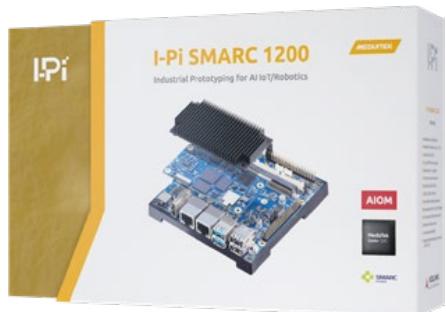
To get started with a wide range of evaluation and development platforms suitable for drone systems, visit ADLINK I-Pi today and lay the foundation for rapid market entry.
![I-Pi SMARC 1200 Industrial Prototyping for AI IoT/Robotics AIOM SMARC TECHNOLOGY](.coms-address-ttm-and-scalability-challenges/58e2f30c6390ff074de7ba14e696d99a4bb20f89db995c48b66e32b3f22b62f4.jpg)

![The image features a red logo shaped like an upward-pointing triangle. Inside the upper portion of the triangle are three horizontal white stripes of varying widths. The bottom edge of the triangle is curved upwards. A registered trademark symbol (®) is visible at the bottom right.](.coms-address-ttm-and-scalability-challenges/f4e20dd20954799a14789a7ba81cc9dea7686e3a28fa8d003c2df352a05eb9ec.jpg)

ADLINK

LEADING EDGE COMPUTING

Tel: +886-3-216-5088

Fax: +886-3-328-5706

Email: service@adlinktech.com

www.adlinktech.com
[🔗 Link to the original document](.coms-address-ttm-and-scalability-challenges/coms-address-ttm-and-scalability-challenges.pdf)