| Core System | SoC | Intel Core S Processor Platform (formerly Bartlett Lake-S) |
| Processor | TDP |
| Core 7 | 65W |
| Core 5 | 65W |
| Core 3 | 65W |
| 1. Additional 45W SKU available on a project basis.2. ECC is supported when paired with the R680E PCH.Supports: Intel® VT (including VT-x / VT-d), Intel® Turbo Boost Technology 2.0, Intel® VNNI, Intel® TCC and Time-Sensitive Networking (TSN), Intel® Hardware Shield, Intel® TXT, Intel® System Security Report, Intel® APIC-v, Intel® PTT, Intel® TDT, Intel® CET, Intel® AMT, Intel® UPID, Intel® PMT, Intel® Thermal Velocity Boost (TVB) (by SKU)Note: Availability of features may vary between processor SKUs. |
| Memory | Up to 128GB (4x 32GB) DDR5 SODIMM memory,max. four sockets (two on top, two at the bottom)Note: It is recommended to check that the bottom side specifications are suitable for your application purposes. |
| Embedded BIOS | AMI UEFI with CMOS backup in 32MB SPI BIOS (dual BIOS opt.) |
| Cache | 36/30/24/12MB |
Note: “Build option””indicates an alternative BOM configuration to support additional or alternative functions that are not available on the standard product. Be aware that these “build option” part numbers will need to be newly created and this will result in production lead times.
Specifications
| Core System | Expansion Busses | 1 PCIe Gen5 x16 at 16-31 and 1 PCIe Gen4 x4 at 8-116 PCIe Gen3 x1 at 0-5 (x4, x2, x1)More lanes with R680E/Q670E (all x4, x2, x1):o 1 PCIe Gen4 x4 at 12-15o 1 PCIe Gen4 x4 at 32-35o 1 PCIe Gen4 x4 at 36-39Note: PCIe lanes 0-5, USB 3.0, SATA, NBASE-T and PCIe_BMC source from HSIO. The available total raw bandwidth is equivalent to PCIe x16 Gen3SMBus, 2x I2C, 1x GP SPI, 1x Boot_SPI and eSPI |
| SEMA Board Controller | Voltage/current monitoring, power sequence debug support, AT/ATX mode control, logistics and forensic information, flat panel control, general purpose I2C, watchdog timer, fan control and failsafe BIOS (dual BIOS by build option) |
| Debug Headers | 40-pin multipurpose flat cable connector for use with DB40-HPC debug module providing BIOS POST code LED, MMC/EC access, SPI BIOS flashing, power testpoints, debug LEDs |
| Video | GPU Feature Support | Intel UHD Graphics 770 driven by Xe architecture, supporting multiple independent and simultaneous display combinations of DisplayPort/HDMI, eDP outputs (4x 4K60)Hardware encode/transcode of HD content (including HEVC)DirectX 12 supportOpenGL 4.6 support |
| Display Interface | DDI 0/1/2 supporting DisplayPort/HDMI/DVIDP1.4a and HDMI2.0b |
| eDP | 4 lane support, eDP 1.4b |
| Audio | Chipset | Intel HD Audio integrated on CPU |
| Audio Codec | On COM-HPC Client Base Carrier (Realtek ALC888) |
| NBASE-T Ethernet | Intel® MAC/PHY | Intel® Ethernet Connection I226 Series |
| Interface | 2x 2.5GbE and 1000/100/10 Mbit/s Ethernet connection |
| Multi I/O and Storage | USB | 4x USB 3.2/2.0/1.1 (USB 0,1,2,3) |
| 4x USB 2.0/1.1 (USB 4,5,6,7) |
| SATA | 2x SATA (SATA 0, 1) |
| Serial | 2x UART ports with console redirection |
| GPIO | 12x GPIO (GPI with interrupt, TBC) |
| TPM (Optional) | Chipset | Infineon |
| Type | TPM 2.0 (SPI based) |
| Power | Standard Input | ATX (TBC): 12V±5% / 5Vsb ±5%; or AT: 12V±5% |
| Management | ACPI 5.0 compliant |
| Power States | TBC |
| ECO mode | TBC |
Note: “Build option””indicates an alternative BOM configuration to support additional or alternative functions that are not available on the standard product. Be aware that these “build option” part numbers will need to be newly created and this will result in production lead times.
Specifications
| Mechanical and Environmental | Form Factor | PICMG COM-HPC: Rev 1.1 Client Type |
| Dimensions | Size C 160X120 mm |
| Operating Temperature | Standard: 0°C to 60°C (storage: -20°C to 80°C) |
| Humidity | 5-90% RH operating, non-condensing5-95% RH storage (and operating with conformal coating) |
| Shock and Vibration | IEC 60068-2-64 and IEC-60068-2-27MIL-STD-202F, Method 213B, Table 213-I, Condition A and Method 214A, Table 214-I,Condition D (TBC) |
| HALT | Thermal Stress, Vibration Stress, Thermal Shock and Combined Test |
| Operating Systems | Standard Support | Windows 11 IoT Enterprise LTSCWindows 10 IoT Enterprise LTSCUbuntu |
# Ordering Information
This section will be updated later.
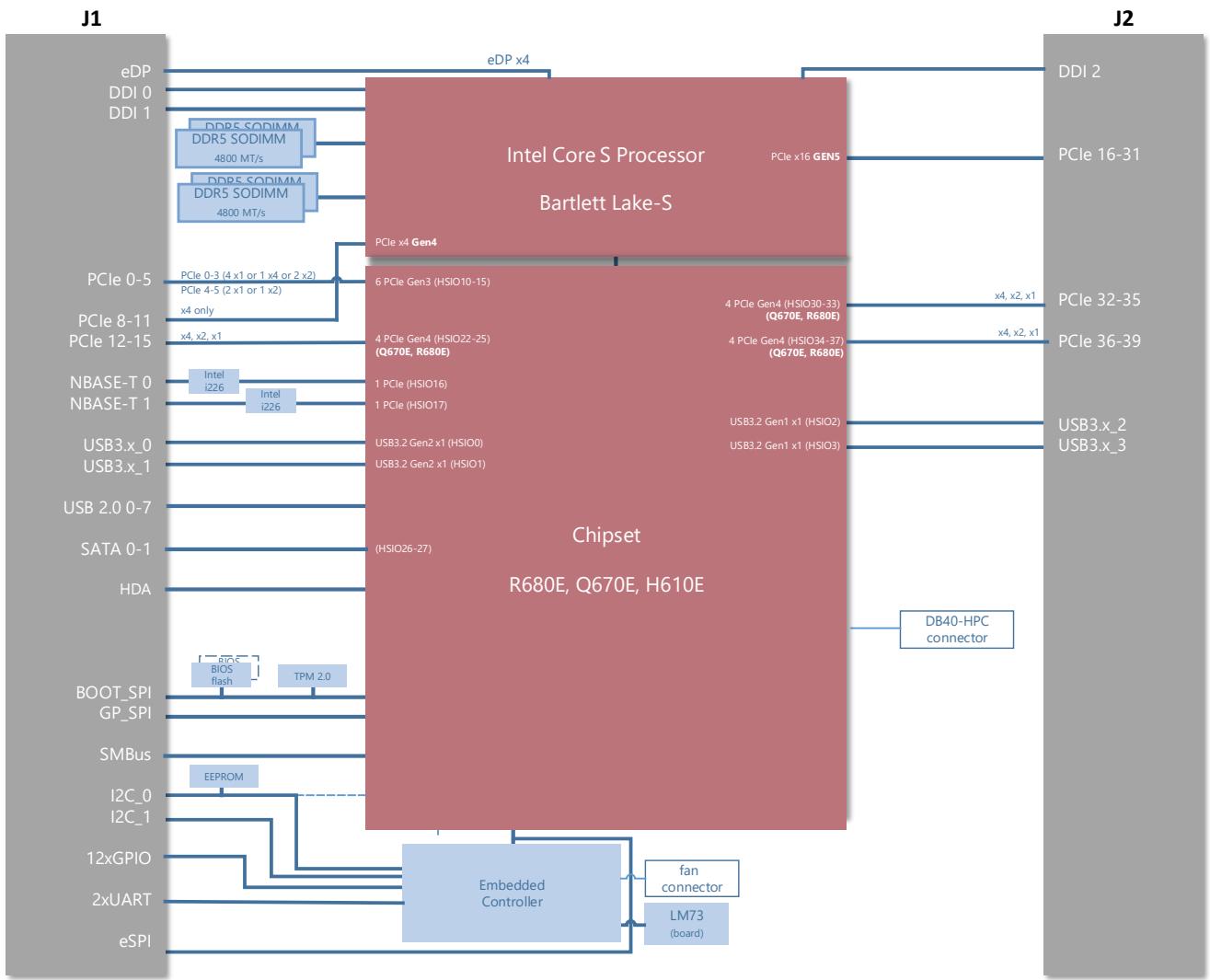
Note: “Build option””indicates an alternative BOM configuration to support additional or alternative functions that are not available on the standard product. Be aware that these “build option” part numbers will need to be newly created and this will result in production lead times.
[🔗 Link to the original document](.preliminary-com-hpc-cbls-datasheet-20250618-2/preliminary-com-hpc-cbls-datasheet-20250618.pdf)