# Spectra ORB

# C++ Edition

# IDL Guide

![in-commerce\ne-commerce](.spectra-orb-c-edition-idl-guide-2/0bdd2afe50bfa2bcceab7c510555e27df280d44ee9e0b940cc4d59c18db16ea0.jpg)

# Spectra ORB

# C++ Edition

# IDL GUIDE

# Copyright Notice

© 2014 PrismTech Limited. All rights reserved.

This document may be reproduced in whole but not in part.

The information contained in this document is subject to change without notice and is made available in good faith without liability on the part of PrismTech Limited or PrismTech Corporation.

All trademarks acknowledged.

# CONTENTS

# Table of Contents

# Preface

About the IDL Guide. . . . . ix

Contacts . . . .

# About IDL

# Chapter 1 Introduction to IDL 3

1.1 Defining the Object’s Interface . . . . .

# Chapter 2 Concepts and Features 5

2.1 IDL Language Basics . . . . . .

2.1.1 IDL Conventions . .

2.1.1.1 Comments . .

2.1.1.2 Identifiers . .

2.1.2 The typedef Mechanism . .

2.1.3 Data Types . . . .

2.1.3.1 Basic Types. . . .

2.1.3.2 Constructed Types . . . . . . 8

2.1.3.3 Template Types . . . .

2.1.3.4 Arrays . . . . . 10

2.1.3.5 The any Type . . . .

2.1.4 Constant Types . . . . . 11

2.1.5 Interfaces . . . . . 12

2.1.5.1 Operations . . . . . . 12

2.1.5.2 Attributes . . . . . 14

2.1.5.3 Exceptions. . . . . 14

2.1.5.4 Inheritance . . 15

2.1.6 Modules . . . . 16

2.1.6.1 The CORBA Module . . . . 17

# C++ Edition Specifics

# Chapter 3 Compiling an IDL Specification 2 1

3.1 Using the IDL Compiler . . . . . . . 21

3.1.1 Command Syntax. . . . . . 21

3.2 IDL Compiler Output. . . . . . . . . . 24

3.2.1 C++ Files Produced . . . . . 25

3.2.2 Using the IDL Compiler Output . . . . . 26

3.2.3 Creating a DLL . . . 26

# Chapter 4 IDL to C++ Mapping 2 9

4.1 Namespaces . . . . . . 29

4.1.1 Scoped Names and Namespaces . . . . . . 29

4.2 Modules . . . . . . . . . 30

4.3 Interfaces . . . . . . . . . 31

4.3.1 The \_var Type . . . . . . 32

4.3.2 Object References . . . . . 33

4.3.3 Object Reference Operations. . . . . . 33

4.3.3.1 Common Operations. . . . . . 33

4.3.3.2 Widening Object References . . . . . . 35

4.3.3.3 Narrowing Object References . . . . . 36

4.4 Data Type Mappings . . . . . . . . . . 37

4.4.1 Constants . . . . . 37

4.4.2 Typedefs . . . . . . 38

4.4.3 Basic Data Types . . . . . . 38

4.4.4 Enums . . . . 39

4.4.5 String Types. . . . . . . 39

4.4.5.1 String\_var . . . . . 40

4.4.6 Structured Types . . . . 41

4.4.6.1 Fixed versus Variable-Length . 41

4.4.7 T\_var Types . . . . . . 42

4.4.8 Struct Types . . . . . . 44

4.4.8.1 Examples . . . . 45

4.4.9 Union Types . . . . . 46

4.4.10 Sequences . . . . . 49

4.4.10.1 Unbounded Sequences . . . . . 49

4.4.10.2 Bounded Sequences . . . . . 53

4.4.10.3 The Sequence \_var Type . . . . . . 55

4.4.11 Array Types . . . . . . 56

4.4.12 Any Types . . . . . . 59

4.4.12.1 Handling Typed Values . . . . . . 60

4.4.12.2 Insertion Into Any. . . . . . . 60

4.4.12.3 Extraction from Any. . . . . . . 62

4.4.12.4 Handling boolean, octet, char, and unbounded string . . . . . . 63

4.4.12.5 Arrays in an Any. . . . . . . 66

4.4.12.6 Extracting to Object . . . . . . 67

4.4.12.7 Handling Untyped Values . . . . . 67

4.4.12.8 Any\_var and Any\_out . . . . . 68

4.5 TypeCodes . . . . . . . . . 69

4.6 Exceptions . . . . . . . . . 71

4.7 Operations and Attributes . . . . . . . . . . 76

4.7.1 Operations . . . . . 76
4.7.2 Attributes . . . . . 76
4.7.3 Parameters . . . . . 76
4.7.3.1 In Parameters . . . 78
4.7.3.2 Inout Parameters . . . . . 79
4.7.3.3 Out Parameters . . . . . 79
4.7.3.4 Return Values . . . . . . 80
4.7.3.5 Primitives . . . . 80
4.7.3.6 Fixed-Length structs and unions. . . . . . 81
4.7.3.7 Fixed-length arrays . . . . . . 83
4.7.3.8 Strings . . . . . . 84
4.7.3.9 Object References. . . . . 85
4.7.3.10 Variable-Length structs and unions . . . . 87
4.7.3.11 Variable-Length arrays . . . . . . 89
4.7.3.12 Sequence and Anys. . . . . . 91

# Index 97

Table of Contents

# P re f a c e

# About the IDL Guide

The Spectra ORB C++ Edition IDL Guide provides instructions and background information needed to understand the IDL language, data types, IDL to C++ mappings, and how to use the Spectra ORB C++ Edition IDL to C++ compiler.

The IDL Guide is intended to be used with the User Guide, as well as the other documents included with Spectra ORB C++ Edition: please refer to the Product Guide for a complete list of documents.

# Intended Audience

The IDL Guide is intended to be used by developers and engineers, working in a distributed computing environment using Spectra ORB, who have a good level of knowledge and experience of CORBA and IDL.

# Organisation

The IDL Guide is organized as follows:

• Chapter 1, Introduction to IDL, introduces the OMG’s Interface Definition Language (IDL).
• Chapter 2, Concepts and Features, describes the IDL basics and provides essential background information.
• Chapter 3, Compiling an IDL Specification describes how to write IDL files.
• Chapter 4, IDL to C++ Mapping, describes the OMG’s IDL to the C++ language mapping for the ORB.

# Conventions

The conventions listed below are used to guide and assist the reader in understanding the IDL Guide.

<table><tr><td>!</td><td>Item of special significance or where caution needs to be taken.</td></tr><tr><td>i</td><td>Item contains helpful hint or special information.</td></tr><tr><td>WIN</td><td>Information applies to Windows (e.g. XP, Vista, Windows 7) only.</td></tr><tr><td>UNIX</td><td>Information applies to Unix-based systems (e.g. Solaris) only.</td></tr><tr><td>C</td><td>C language specific.</td></tr><tr><td>C++</td><td>C++ language specific.</td></tr><tr><td>Java</td><td>Java language specific.</td></tr></table>

Hypertext links are shown as blue italic underlined.

On-Line (PDF) versions of this document: Items shown as cross references to other parts of the document, e.g. Contacts on page x, are hypertext links: jump to that section of the document by clicking on the cross reference.

```txt
% Commands or input which the user enters on the command line of their computer terminal
```

Courier fonts indicate programming code and file names.

Extended code fragments are shown as small Courier font in shaded boxes:

```javascript
NameComponent newName[] = new NameComponent[1];
// set id field to "example" and kind field to an empty string scarf
newName[0] = new NameComponent("example", "");
```

Italics and Italic Bold are used to indicate new terms, or emphasise an item.

Arial Bold is used to indicate user-related actions, e.g. File > Save from a menu.

Step 1: One of several steps required to complete a task.

# Contacts

PrismTech can be reached at the following contact points for information and technical support.

USA Corporate Headquarters

PrismTech Corporation

400 TradeCenter

Suite 5900

Woburn, MA

01801

USA

Tel: +1 781 569 5819

European Head Office

PrismTech Limited

PrismTech House

5th Avenue Business Park

Gateshead

NE11 0NG

UK

Tel: +44 (0)191 497 9900

Fax: +44 (0)191 497 9901

Web: http://www.prismtech.com

Technical questions: crc@prismtech.com (Customer Response Center)

Sales enquiries: sales@prismtech.com

# ABOUT IDL

# CHAPTER

# 1 Introduction to IDL

The Interface Definition Language (IDL) enables interfaces to be defined which are independent of any particular programming language. This enables the components of CORBA-based distributed applications to be written in whichever programming language is most appropriate, where different components of the same application can even be written in different languages. For example, a client could be written in Java and a server in C, C++, or even COBOL.

This capability provides enormous power and flexibility, especially where legacy applications must be made to communication with new applications or components which have been written in a different language.

In CORBA, the object’s interface defines the operations the object provides and how a client interacts with the object. The interface represents the contract between an object and a client that attempts to use that object. The interface defines the object’s reference and allows an object to declare its type and the names of its inherited types. It also provides the names of the operations it supports and the parameters and return types of those operations.

To implement an object described in IDL, the interface description must be translated into the appropriate programming language constructs as defined by CORBA’s IDL mapping for that language. Translation is performed by an IDL compiler supplied with the ORB. The IDL compiler is described in Using the IDL Compiler on page 19.

The IDL to C language mapping is compliant with the OMG C Language Mapping Specification, OMG document 99-07-35.

# 1.1 Defining the Object’s Interface

In IDL, an object’s interface consists of a set of named operations and the parameters supplied to those operations. The following example shows how IDL would define the interface of an object in a simple application:

```txt
interface SimpleObject
{
    boolean oneOperation (in string aString);
    void anotherOperation (in string anotherString);
};
```

A description of an interface in IDL is called an IDL specification of that interface. IDL specifications should be created in a source file with a .idl file extension.

IDL source files are passed to the ORB’s IDL compiler, to generate new files with programming-language constructs and implementations that can be used in an application. The IDL interface construct maps directly to the programming language’s construct for an object reference:

The following sections describe IDL and the constructs you can use to define an object’s interface.

# CHAPTER

# 2 Concepts and Features

The OMG’s Interface Definition Language (IDL) is a modelling language for defining interfaces. The interface definitions created are platform and language independent. The IDL interface definitions enable applications, which have been implemented in different programming languages, for example C, C++, Java, or even COBOL, to transparently communicate with each other through ORB middleware.

IDL compilers generate programming code for specific languages (such C, C++, Java, or COBOL) using the IDL interface definitions mentioned above. An individual IDL compiler is designed to generate programming code for a specific language and in accordance with an appropriate mapping specification defined by the OMG.

IDL compilers use the interface definitions to create the appropriate classes, methods, operations, parameters and attributes needed for the specific programming language used by the developer. The developers use the IDL-generated files as the basis for implementing client and server components of their distributed, CORBA-based applications.

This section describes the basics of the IDL language and how to use it to create programming language-specific applications. The complete description of the syntax and semantics of IDL are given in the OMG’s Common Object Request Broker Architecture and Specification document.

# 2.1 IDL Language Basics

The IDL syntax is similar to C++ syntax. The key differences between IDL and C++ syntax are:

• a function return type is mandatory
• a name must be supplied with formal parameter in an operation declaration
• a parameter list consisting of a single void token does not act as an empty parameter list
• tags are required for structures, discriminated unions, and enumerations
• integer types cannot be declared as int or unsigned; they must be explicitly declared as short, long, or long long
• char types cannot be qualified as signed or unsigned

# 2.1.1 IDL Conventions

The Interface Definition Language uses the conventions described below.

# 2.1.1.1 Comments

There are two comment delimiters in IDL:

• The comment pair /\* and \*/ is used to delimit comments that span multiple lines.
• The double slash // begins a comment that is terminated at the end of a line. The comment may be placed after a code statement on the same line or on a line by itself.

Comments do not nest.

# 2.1.1.2 Identifiers

Identifiers are names for IDL definitions such as constants, types, and operations. An identifier is an arbitrarily long sequence of letters, digits, and the underscore (\_) character. Identifiers must begin with a letter.

In this example, MaxVal is an IDL identifier for a long integer:

long MaxVal;

Identifiers are scoped. See Modules on page 16 for information on how scoping works with identifiers.

Identifiers are case sensitive in that a given identifier must be spelled identically with respect to case throughout an IDL specification. However, using two different identifiers which differ only in case will produce a compilation error.

IDL reserves a set of keywords that cannot be used as identifiers. These reserved keywords are shown in Table 1, IDL Keywords.

Table 1 IDL Keywords

<table><tr><td>abstract</td><td>double</td><td>local</td><td>raises</td><td>truncatable</td></tr><tr><td>any</td><td>enum</td><td>long</td><td>readonly</td><td>typedef</td></tr><tr><td>attribute</td><td>exception</td><td>module</td><td>sequence</td><td>unsigned</td></tr><tr><td>boolean</td><td>factory</td><td>native</td><td>short</td><td>union</td></tr><tr><td>case</td><td>FALSE</td><td>Object</td><td>string</td><td>ValueBase</td></tr><tr><td>char</td><td>fixed</td><td>octet</td><td>struct</td><td>valuetype</td></tr><tr><td>const</td><td>float</td><td>oneway</td><td>supports</td><td>void</td></tr><tr><td>context</td><td>in</td><td>out</td><td>switch</td><td>wchar</td></tr><tr><td>custom</td><td>inout</td><td>private</td><td>TRUE</td><td>wstring</td></tr><tr><td>default</td><td>interface</td><td>public</td><td></td><td></td></tr></table>

# 2.1.2 The typedef Mechanism

Use the typedef mechanism to name a data type. A typedef definition begins with the keyword typedef, followed by the data type and typedef name. You can name basic data types, constructed data types, and template types using typedef declarations. typedefs are typically used to name template types, such as sequences and arrays.

# 2.1.3 Data Types

IDL supports the basic data types such as char, short, long, and float; structured types such as structs, unions, and enumerations; template types such as sequences, arrays, and strings; and structured exceptions. The interface type can also be used as an operation parameter. An interface argument is passed as an object reference that refers to the instance of the object implementation it represents. CORBA defines an any type that can represent any IDL type and can be used as an argument or value type wherever multiple different types are acceptable. You can use typedefs or create an alias for any of these types.

An IDL compiler for a specific programming language maps basic IDL data types to the appropriate native data types of that programming language.

# 2.1.3.1 Basic Types

Table 2, Basic IDL Data Types lists the basic IDL data types.
Table 2 Basic IDL Data Types

<table><tr><td>IDL Identifier</td><td>Type</td><td>Description</td></tr><tr><td>any</td><td>Any type</td><td>Self-describing values that can express any IDL type</td></tr><tr><td>boolean</td><td>Boolean type</td><td>1 or 0 (zero)</td></tr><tr><td>char</td><td>Char type</td><td>8-bit ISO Latin 1 characters</td></tr><tr><td>double</td><td>Floating-point Type</td><td>IEEE double-precision floating-point numbers</td></tr><tr><td>float</td><td>Floating-point Type</td><td>IEEE single-precision floating-point numbers</td></tr><tr><td>long</td><td>32-bit integer</td><td>-2^31 ... 2^31-1</td></tr><tr><td>long double</td><td>Floating-point type</td><td>IEEE double-extended floating-point numbers</td></tr><tr><td>long long</td><td>64-bit integer</td><td>-2^63 ... 2^63-1</td></tr><tr><td>octet</td><td>Octet type</td><td>8-bit quantity that is guaranteed not to undergo any conversion during communication</td></tr><tr><td>short</td><td>16-bit integer</td><td>-2^15 ... 2^15-1</td></tr><tr><td>unsigned long</td><td>32-bit integer</td><td>0 ... 2^32-1</td></tr><tr><td>unsigned long long</td><td>64-bit integer</td><td>0 ... 2^64-1</td></tr><tr><td>unsigned short</td><td>16-bit integer</td><td>0 ... 2^16-1</td></tr></table>

# 2.1.3.2 Constructed Types

IDL provides three constructed data types: structures, unions, and enumerations.

# 2.1.3.2.1 Structures

A structure allows related data to be grouped under a single name. Structures are declared with the keyword struct, followed by an identifier and a list of members enclosed in braces. Each struct member must be an IDL type1 .

This example of an IDL structure named date has three members: two of type unsigned short and one of type short.

```c
struct date
{
    unsigned short month;
    unsigned short day;
    short year;
};
```

# 2.1.3.2.2 Discriminated Unions

A union groups items of different types and sizes, but only one member of the union has a useful value at any one time. This implies a saving in the amount of storage allocated to a union.

Discriminated unions use a discriminator (or switch) to help keep track of which union member has the most current value assigned to it. Each member of an IDL discriminated union has an associated case label which must match (or be castable to) the type of the switch field. The switch field uses the case label to determine which union member to use. An optional member with a default case label can be used. Access to the switch and the related element is language-mapping dependent.

An IDL discriminated union is declared with the keyword union, followed by an identifier for the union. This is followed by the keyword switch and a switch type enclosed in parentheses. Finally, a list of members that have case labels is enclosed in braces. Each union member must be an IDL type.

The switch type can be long, long long, short, unsigned long, unsigned long long, unsigned short, char, boolean, or enum.

This example shows an IDL discriminated union named token.

```txt
union token switch (long)
{
    case 1: char cval;
    case 2: float fval;
    case 3: double dval;
    default: long lval;
};
```

# 2.1.3.2.3 Enumerations

An enumeration is an ordered list of identifiers, referred to as enumerators. Enumerations are declared with the keyword enum, followed by an identifier and a comma-separated list of enumerators enclosed in braces.

The order in which the identifiers are named defines their relative order. This order allows two enumerators to be compared. By default, the first enumerator has a value of 0; the value of each subsequent enumerator is incremented by one.

This example shows an IDL enumerated type named workday.

```txt
enum workday { Monday, Tuesday, Wednesday, Thursday, Friday };
```

# 2.1.3.3 Template Types

IDL provides template data types: sequences, strings, and fixed.

# 2.1.3.3.1 Sequences

# Example

A sequence is a one-dimensional array that can be declared with an optional maximum size. If the sequence is declared with a maximum size, it is referred to as a bounded sequence; if no maximum size is specified, it is referred to as an unbounded sequence. The length of a sequence can change dynamically but the length of a bounded sequence cannot exceed the maximum size fixed at compile time. Sequence elements can be any of the IDL types.

This example shows a bounded sequence. The keyword typedef names the sequence data type.

```txt
typedef sequence&lt;long, 64&gt; vec64;
```

This example shows an unbounded sequence named vec.

typedef sequence&lt;long&gt; vec;

# 2.1.3.3.2 Strings

A string is a one-dimensional array of 8-bit ISO Latin1 characters that can be declared with an optional maximum length. If the string is declared with a maximum length, it is referred to as a bounded string; if no maximum length is specified, it is referred to as an unbounded string. The length of a string can change dynamically but the length of a bounded string cannot exceed the maximum length fixed at compile time.

This example shows a bounded string. The keyword typedef names a bounded string data type:

typedef string&lt;16&gt; name16;

This example shows an unbounded string named name:

typedef string name;

# 2.1.3.3.3 Wide Strings

Wide types (wchar/wstring) are not supported. By default wide types are treated as the non-wide equivalent (string/char) type. If the -no\_map\_wide IDL compiler flag is used then the compiler generates an error if a wide type is used.

# 2.1.3.3.4 Fixed

The fixed type represents fixed point decimal numbers with a specified number of significant digits and scale factor. There can be no more than 31 significant digits in a given fixed point number. The scale factor is a non-negative integer less than or equal to the number of significant digits.

This example defines a Money type capable of storing 9-digit figures, 2 of which are to the right of the decimal point.

typedef fixed&lt;9,2&gt; Money;

The fixed point type can also be used to define integer types with a specified number of significant digits by setting the scale factor to 0. This is illustrated in the following example.

typedef fixed&lt;31,0&gt; BigInteger;

# 2.1.3.4 Arrays

IDL defines multi-dimensional, fixed-size arrays. Each dimension of the array has an explicit fixed size that cannot vary at runtime.

An array is declared with a type specifier, an identifier, and the dimensions enclosed in bracket pairs.

• any of the IDL types may be made into a multi-dimensional array.
• each dimension must be a positive integer constant expression.

This example defines a one-dimensional array of bounded strings:

```txt
typedef string&lt;20&gt; FiveStrings[5];
```

This example defines a two-dimensional matrix of longs:

```javascript
typedef long LongMatrix[4][4];
```

# 2.1.3.5 The any Type

The any type can express any legal IDL value. An any is self-describing and is intended to be used as an argument or value type wherever multiple different types are acceptable. An any can be passed as an operation argument.

An any contains a TypeCode and a value which is of the type indicated by the TypeCode. The any type can be any IDL-specified type, including another any. The TypeCode allows applications that use it to interpret the type of the data the any contains.

The any maps into an implementation-language mapped type.

i Support for anys must be enabled in the idlcpp compiler by using the -gen\_any command-line switch and linking in the correct any libraries. The C Any type mapping is defined in the eOrbC/CORBA/any.h header file and must be included.

# 2.1.4 Constant Types

A constant provides a way to declare types that are initialized with values that cannot be changed. Constants are declared with the keyword const, followed by a type specifier, an identifier, the assignment operator (=), and the value to which the constant is initialized.

Table 3, Constants, on page 11 lists the IDL types which can be used to declare constants.

Table 3 Constants

<table><tr><td>boolean</td><td>short</td></tr><tr><td>char</td><td>string</td></tr><tr><td>double</td><td>unsigned long</td></tr><tr><td>fixed</td><td>unsigned long long</td></tr><tr><td>float</td><td>unsigned short</td></tr><tr><td>long</td><td></td></tr><tr><td>long long</td><td></td></tr><tr><td>octet</td><td></td></tr></table>

This example declares a constant MaxVal of type long with a fixed value of 100:

```javascript
const long MaxVal = 100;
```

![The image features a vertical strip showing a single, lowercase blue letter 'i' set against a white background.](.spectra-orb-c-edition-idl-guide-2/124b1aa1fae51faefedd8d21200c339a7c08a63740ab40004e76c0320dc11c15.jpg)

Long long and unsigned long long constants are limited to long and unsigned long values on platforms with compilers that do not have built-in long long support.

# 2.1.5 Interfaces

An interface is defined with the keyword interface followed by an identifier that names the interface. The interface identifier may optionally be followed by an inheritance specification and the interface body enclosed in braces. The body of an interface may include IDL type definitions.

A forward declaration of an interface consists simply of the keyword interface followed by an identifier.

An interface forms a naming scope for identifiers. An identifier that is defined within an interface can have the same name as an identifier that is defined outside the interface. An identifier that is defined within an interface can be used outside of the interface when it is qualified with the name of the interface and the name resolution operator ( :: ).

This example shows an IDL specification with an interface object that provides options to start and stop, and returns the errors of a ManagedElement.

```cpp
enum error{NO_ERROR, ELEMENT_BUSY, ELEMENT_NOT_RESPONDING};
typedef sequence&lt;error&gt; errors;
interface ManagedElement
{
    // Management operations
    boolean start();
    boolean stop();
    errors get_errors();
};
```

The example uses enum to define error, which enumerates the possible errors. The typedef statement defines errors as a sequence of the enum error. The ManagedElement interface contains start() and stop() operations, which return boolean type values, and a get\_errors() operation that has a return value of type errors.

# 2.1.5.1 Operations

Operation declarations occur in an interface body. Operation declarations consist of a return type followed by an identifier that names the operation, a parameter list enclosed in parentheses, and an optional raises expression.

# 2.1.5.1.1 Return Type

An operation must specify a return type. Return types can be any IDL type. If an operation does not return a result, it must specify the void type.

# 2.1.5.1.2 Parameter Declarations

A parameter list consists of zero or more parameter declarations separated by commas. A parameter declaration consists of a directional attribute followed by an IDL data type and an identifier that names the parameter. The directional attribute specifies the direction in which the parameter is to be passed. Table 4, Directional Attributes lists the IDL directional attributes.

Table 4 Directional Attributes

<table><tr><td>Attribute</td><td>Meaning</td></tr><tr><td>in</td><td>The parameter is passed from the client to the server</td></tr><tr><td>out</td><td>The parameter is passed back from the server to the client</td></tr><tr><td>inout</td><td>The parameter is passed in both directions</td></tr></table>

The following example illustrates an operation which uses the keyword out to specify that the greetstr string is passed from object to client.

string greeting (out string greetstr);

# 2.1.5.1.3 Oneway Operations

An operation declaration can be preceded by the optional keyword oneway. A oneway operation is a non-blocking call (it does not suspend the client when it makes the request). A oneway operation is invoked once at most, and delivery of the call is not guaranteed. If the request fails after being issued, the client is not notified. The return type of a oneway operation must be void and the parameter list must not contain any inout or out parameters. Oneway operations can only raise standard exceptions, and will only raise those exceptions if the client ORB encounters an error prior to sending the request.

The following example declares an interface with a single oneway operation:

```lisp
interface alarms
{
    oneway void notify (in string event);
};
```

# 2.1.5.1.4 Raises Expressions

A raises expression specifies which exceptions may be raised by an operation. the expression consists of the keyword raises followed by a list of exceptions enclosed in parentheses. The exception list must consist of one or more previously-defined exceptions separated by commas.

The following example declares that a single exception, NotRunning, may be raised by the stop operation.

```txt
boolean stop () raises (NotRunning);
```

The raises expression specifies any operation-specific exceptions that may be raised by a call to the operation. In addition to these exceptions, IDL defines a set of standard system exceptions which can be raised by the ORB as a result of a call to the operation. These system exceptions must not be listed in a raises expression. System exceptions may be raised by the ORB even if no operation-specific exceptions have been defined.

# 2.1.5.2 Attributes

In addition to operation declarations, an interface body can have attribute declarations. An attribute is declared with the keyword attribute, which can be preceded by the optional keyword readonly, followed by a type specifier and an identifier.

To enable a client to access an attribute value, the IDL compiler maps an IDL attribute declaration to two functions: one to set the value of the attribute and one to retrieve the value of the attribute. The set function takes an input parameter of the same type as the attribute; the get function returns a value of the same type as the attribute. If an attribute is defined as readonly, it maps only to the get function.

The following example defines an interface with a single attribute, the string element\_owner.

```txt
interface ManagedElement
{
    attribute string element_owner;
};
```

# 2.1.5.3 Exceptions

An exception is a data structure that is returned to indicate that a particular type of exceptional condition occurred as a result of a request on an object. There are two types of exceptions: user exceptions and standard exceptions.

# 2.1.5.3.1 User Exceptions

The exception data structure is similar to a struct in syntax and form. User exceptions are declared with the keyword exception and an identifier followed by an optional list of members enclosed in braces. The members of an exception provide additional information you can use to determine which exceptional condition occurred or more detail about the exception that occurred.

Exceptions can not be used as parameters to operations or members of elements or other data types.

To specify what types of exceptions an operation can raise, an optional raises expression can follow the parameter list of an operation declaration. See Raises Expressions on page 14 for details.

The following example declares an exception named no\_operating\_info in the ManagedElement interface. The reason member of the no\_operating\_info exception can be used to specify the reason a status could not be returned by the get\_state() operation. The exception may be raised by the status operation.

```txt
interface ManagedElement
{
    exception no_operating_info { string reason };

    status get_state (out operating_info current_state)
    raises (no_operating_info);
};
```

# 2.1.5.3.2 System Exceptions

CORBA defines a set of system exceptions that correspond to standard runtime errors that the ORB may signal as a result of any request. These exceptions are implicitly listed in every operation's raises expression.

The User Guide includes a list of system exceptions and their minor codes as well as where the exceptions are thrown.

# 2.1.5.4 Inheritance

Inheritance is a mechanism for defining an interface by adding new elements to an existing interface. An existing interface which the new interface inherits from is called a base interface of the new interface. An interface can be derived from any number of base interfaces.

To specify that one interface inherits from another, follow the interface name in the interface definition with a colon ( : ) and the name of the interface it inherits from. If an interface inherits from multiple interfaces, use commas to separate their names.

A derived interface inherits all the elements (constants, types, attributes, exceptions, and operations) of the base interfaces from which it is derived. If more than one base interface uses the same name for a constant, type, or exception, qualify the name with its interface name in the derived interface. A derived interface cannot inherit from two interfaces that contain the same operation or attribute name. Additionally, a derived interface cannot redefine an inherited operation or attribute name.

The following example specifies that the interface GroupManagedElement inherits from the previously-defined ManagedElement interface.

```typescript
interface GroupManagedElement : ManagedElement
{
    // new operations and attributes
};
```

There can be multiple levels of inheritance. For example, interface X can inherit from base interface Y which in turn inherits from base interface Z. In this situation, Z is called an indirect base interface of X. Y is a direct base interface of X.

# 2.1.6 Modules

Modules can be used to control the naming scope of identifiers. By properly scoping IDL declarations within modules, you can avoid conflicts between identifiers in different modules. An identifier that is defined within a module can have the same name as an identifier that is defined outside the module.

The following example uses two MaxVal identifiers, one within a module named business and the other outside of the module.

```javascript
const long MaxVal = 100;
module business
{
    const long MaxVal = 50;
};
```

An identifier defined within a module can be used outside of that module when it is qualified with the name of the module and the name resolution operator ( :: ). In the example above, the MaxVal identifier defined within the business module can be referred to using business::MaxVal.

Modules can be used to scope identifiers of IDL data types, constants, exceptions, interfaces, and other modules.

The following example uses modules to control the scope of two interface definitions with the same name:

```txt
module Europe
{
    interface ManagedElement
    {
    // operations
    };
};
module USA
{
```

```txt
interface ManagedElement
{
    // operations
};
```

An identifier can only be defined once in a module, however it can be redefined in nested modules. An identifier can be used in an unqualified form within a particular module and will be resolved by successively searching farther out in enclosing modules.

# 2.1.6.1 The CORBA Module

The CORBA specification includes pre-defined names which can be used in your IDL specification. This includes interface names such as TypeCode. To avoid conflicts between pre-defined CORBA names and user-defined names, CORBA names are defined in a CORBA module. To use CORBA names in your IDL specification, qualify them with CORBA::, for example, CORBA::TypeCode.

This does not apply to IDL keywords. For example, use Object instead of CORBA::Object.

# C++ EDITION SPECIFICS

# CHAPTER

# 3 Compiling an IDL Specification

The first step in developing an application is to define the IDL specification. The IDL files are then compiled into C++ source and header files using the ORB’s IDL to C++ compiler, idlcpp.

# 3.1 Using the IDL Compiler

Interface specifications written in IDL are stored in IDL source files. These files must have an .idl extension in order to be recognised by the IDL compiler.

T h e O R B ’s I D L t o C + + c o m p i l e r, i d l c p p , i s l o c a t e d i n t h e \$ E OR B H O M E / bi n / \$ E O RB E N V d i rectory (o n Wi nd ows u se %EORBHOME%\bin\%EORBENV%).

# 3.1.1 Command Syntax

The idlcpp compiler is run from the command line as follows:

```txt
% idlcpp [options] &lt;idl_files&gt;
```

where

&lt;idl\_files&gt; is a list of one or more developer-written IDL source files [options] is a list of zero or more command-line options.

Using idlcpp with no parameters or with the -u option displays usage information.

The complete list of command-line parameters is described in Table 5, IDL to C++ Compiler Options, on page 22. Note that command-line parameters are case sensitive (U and u perform different functions, for example).

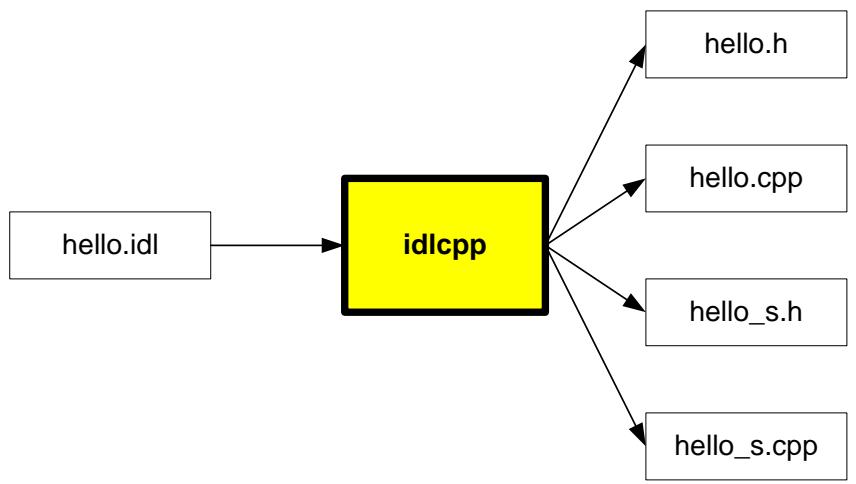
The IDL compiler’s default behaviour is to create four C++ source files for each IDL file (the number, type and names of output files can be changed with the command line options). The standard generated source files include:

• a client header file (containing the stub declarations) with a .h extension, e.g. myfile.h
• a client implementation file (containing the stub definitions) with a .cpp extension, e.g. myfile.cpp
• a server implementation base header file with a \_s suffix and .h extension, e.g. myfile\_s.h, which contains the skeleton and/or tie declarations

• a servant implementation base file with a \_s suffix and .cpp extension, e.g. myfile\_s.cpp, which contains the skeleton base or tie class definitions

The first two files listed above are for clients; the second two are for servers. Only the client or server files can be generated if desired: refer to the IDL Guide for the appropriate command line option to use.

# Example

To generate the client and server stub and skeleton files from an IDL source file called myapp.idl use:

```batch
% idlcpp myapp.idl
```

This will generate:

• myapp.h and myapp.cpp, the C++ client header and implementation files (containing the stub)
• myapp\_s.h and myapp\_s.cpp, the C++ server header and implemention files (containing the skeleton)

Table 5 IDL to C++ Compiler Options

<table><tr><td>Option</td><td>Description</td></tr><tr><td>-chs=</td><td>Generated client header suffix (default .h)</td></tr><tr><td>-cis=</td><td>Generated client implementation suffix (default .cpp)</td></tr><tr><td>-client_only</td><td>Generates only the client files.</td></tr><tr><td>-collocated_direct</td><td>Generate code for direct servant invocation.</td></tr><tr><td>-D[=value]</td><td>Defines name and an optional value for use with preprocessor conditional directives in the IDL specification file. White space between the -D and the name is optional. This option can be repeated to specify multiple preprocessor directives.</td></tr><tr><td>-E</td><td>Only runs the pre-processor, printing the output.</td></tr><tr><td>-enum32</td><td>Can be used when enumerated types map naturally to 32-bit values. Prevents generation of additional enumeration to force size.</td></tr><tr><td>-[no]exceptions</td><td>Generate code to support native or non-native exceptions (as opposed to portable macros).</td></tr><tr><td>-gen_any</td><td>Generates code to support insertion and extraction of IDL types using anys. This flag must be used for IDL files which contain anys.</td></tr><tr><td>-gen_names</td><td>Generates code to support operations that return id, name, and member_name for TypeCodes and dynamic anys.
Setting this flag automatically sets the gen_any flag.</td></tr><tr><td>-gen_tie</td><td>Generates a tie template class for each interface. By default, idlcpp does not generate tie templates.</td></tr><tr><td>-I&lt;directory&gt;</td><td>Adds directory to the list of directories to be searched for included IDL files.</td></tr><tr><td>-ignore_interfaces</td><td>Do not generate interface code.</td></tr><tr><td>-import_export=&lt;macro&gt;</td><td>Generates all of the code necessary to import or export the generated classes from a user-built Dynamic Link Library for Windows. See Creating a DLL on page 26 for more details.</td></tr><tr><td>-M</td><td>Generate code for included files</td></tr><tr><td>-no_map_wide</td><td>Do not map wchar/wstring types to char/string. Generate compiler error instead.</td></tr><tr><td>-max_char=&lt;num&gt;</td><td>Sets the maximum number of characters per line for generated files. If a line in the IDL file exceeds num characters, the line is split by a backslash character (\) and continued on a new line. The default maximum number of characters per line is 1024.</td></tr><tr><td>-no_warn</td><td>Disable warning messages.</td></tr><tr><td>-o or -output &lt;dir&gt;</td><td>Generates output into specified directory.</td></tr><tr><td>-shs=&lt;suffix&gt;</td><td>Generated server header suffix (default _s . h)</td></tr><tr><td>-sis=&lt;suffix&gt;</td><td>Generated server implementation suffix (default _s . cpp)</td></tr><tr><td>-strip_includes</td><td>Strips path information from #include directives in the generated code. For example: #include "common/types.idl" in an IDL file will be translated into #include "types.h" in the generated code.</td></tr><tr><td>-u</td><td>Displays usage message and exits. Note that this is a lower-case u.</td></tr><tr><td>-U</td><td>Removes any initial definition of the preprocessor directive name. This option can be repeated to undefined multiple names. This is the opposite of the -D option. White space between the -U and the name is optional. Note that this is an upper-case U.</td></tr><tr><td>-v</td><td>Traces compilation stages. Note that this is a lower-case v.</td></tr><tr><td>-V</td><td>Prints compiler version information and exits. Note that this is an upper-case V. -version can also be used to display version information.</td></tr><tr><td>-w</td><td>Suppresses compiler warning messages.</td></tr></table>

# 3.2 IDL Compiler Output

The IDL to C++ compiler will generate the four files shown in Figure 1 for an IDL specification file called hello.idl.
![The flowchart depicts a one-to-many process flow:\n\n*   **Input:** A block on the left labeled **hello.idl** has an arrow pointing to the right, connecting into a central block.\n*   **Process:** The central block is labeled **idlcpp** and is highlighted in yellow with a thick black border.\n*   **Outputs:** Four arrows originate from the right side of the **idlcpp** block, pointing to four separate blocks stacked vertically on the right. From top to bottom, these blocks are labeled:\n    *   **hello.h**\n    *   **hello.cpp**\n    *   **hello_s.h**\n    *   **hello_s.cpp**](.spectra-orb-c-edition-idl-guide-2/bbd0955935f5a707d53207fc47bcb8bcb4725d5c97ae7ba9d8ebe9e814ce7dc8.jpg)

Figure 1 Example Generated C++ Files

Note that this is the default output from the IDL compiler. The number, type, and names of the output files can be changed with command-line options (given in Table 5, IDL to C++ Compiler Options, on page 22).

# 3.2.1 C++ Files Produced

• hello.h is the client header file containing stub declarations. It defines the C++ types associated with the IDL types defined in the IDL specification. The C++ types in this header file are used by client programs and object implementations. This header file provides a C++ abstract base class for every interface construct in the IDL specification. For clients, this header file provides remote access to object references through stubs that correspond to the IDL-defined interface operations. An ORB client program includes this header file and makes a request by calling one of the stub routines on an object reference.
• hello.cpp is the client implementation file containing stub definitions. It contains implementations of the types declared in hello.h. The interface implementation file is compiled and linked with an ORB client program and with object implementations.
• hello\_s.h is the server implementation base header file containing the skeleton and tie declarations. It provides C++ types that you use in your object implementation. An ORB object implementation file includes this header file, which in turn includes the interface header file, hello.h. If the -gen\_tie compiler switch is used, hello\_s.h will also contain the tie template class definition.

• hello\_s.cpp is the server implementation base file containing the skeleton and tie class definitions. It contains the implementations of operation dispatch functions required by object implementations. The object implementation dispatch file is compiled and linked with an ORB object implementation.

# 3.2.2 Using the IDL Compiler Output

The header files produced by the IDL compiler are used as follows:

• the client’s modules must include the client header file (using a #include directive)
• the server’s modules must include the server header file (using a #include directive)

The client and server implementation files produced by the IDL compiler should be compiled and linked with the application.

# 3.2.3 Creating a DLL

![The image displays a white rectangular area enclosed by a black border. Inside this border, the word 'WIN' is written in blue, uppercase letters.](.spectra-orb-c-edition-idl-guide-2/4ee561c06b7c1d9130d3153d473ba3d646fe10d5c4c0ee9d0a85cec91f714d33.jpg)

A Win32 DLL (Dynamic Link Library) can be created by the IDL compiler by using the -import\_export=&lt;macro&gt; command-line option.

. The following example illustrates this with the MY\_DLL macro:

```batch
% idlcpp -import_export=MY_DLL hello.idl
```

This inserts an import/export block into hello.h as follows:

```cmake
#if defined(_WIN32)
    if defined(EORB_BUILD_MY_DLL)
    define MY_DLL __declspec(dllexport)
    elif defined(EORB_NO_MY_DLL)
    define MY_DLL
    else
    define MY_DLL __declspec(dllexport)
    endif
#else
#define MY_DLL
#endif
```

When compiling the generated source into a DLL, -DEORB\_BUILD\_MY\_DLL must be used. This ensures that the appropriate symbols are declared as exported from the resulting DLL (by declaring \_\_declspec(dllexport)).

When compiling the generated source into a static library, and when compiling other code that is to be linked with the resulting static library, -DEORB\_NO\_MY\_DLL must b e u s e d t o e n s ur e t h a t t h e r e i s n o \_\_ d e c l s pe c ( d l l i mp o r t ) or \_\_declspec(dllexport) declaration.

If neither -DEORB\_BUILD\_MY\_DLL nor -DEORB\_NO\_MY\_DLL are used then the appropriate symbols will be declared as \_\_declspec(dllimport), which is effectively “standard” behaviour for a C++ file.

# CHAPTER

# IDL to C++ Mapping

This section describes the IDL to the C++ language mapping for Spectra ORB C++ Edition. Applications, clients or servers which conform to the constructs described here will be portable across conforming ORB implementations.

i The ORB’s IDL to C++ compiler conforms to the OMG’s C++ Language Mapping Specification Version 1.0.

# 4.1 Namespaces

Names in IDL can be scoped within a module or an interface in order to avoid identifier conflicts. This mapping ensures that you can use each of the types defined in the IDL specification without ambiguity.

# 4.1.1 Scoped Names and Namespaces

Names which are scoped in IDL are mapped to C++ scoped names as follows:

• modules can be mapped to C++ namespaces
• interfaces are mapped to C++ classes
• All IDL constructs which are scoped to an interface or module are accessed via C++ scoped names. For example, if a type Mode were defined in interface Printer, the type would be referred to as Printer::Mode.

These mappings allow corresponding mechanisms to be used in both IDL and C++ to build scoped names. For example, the IDL is logically mapped into C++ as:

```txt
// IDL
module M
{
    struct S
    {
    // definitions
    };

    union U
    {
    // definitions
    };
};
```

```txt
// C++
namespace M
```

```txt
{
    struct S
    {
    // definitions
    };
    union U
    {
    // definitions
    };
};
```

The following are legal scoped names in C++:

```txt
// C++
M::S s;
M::U u;
```

Alternatively, employing the C++ using statement allows you to specify the name without explicitly using scoping.

```txt
// C++
using namespace M;
S s;
U u;
```

# 4.2 Modules

A module defines a scope and maps to a C++ namespace with the same name:

```txt
// IDL
module M
{
    // definitions
};
```

```txt
// C++
namespace M
{
    // definitions
}
```

# Example Mapping to namespace

The IDL module M mapping to namespace is shown below.

```txt
// IDL
module M
{
    // definitions
};
```

# 4.3 Interfaces

IDL interfaces are mapped to abstract C++ classes using the same name and scope as the interface. The interface class includes methods for each of the operations and attributes that the interface supports. The interface class contains public C++ definitions for each of the IDL types defined in the scope of the interface in IDL.

Each interface class is derived from CORBA::Object, which defines behaviours common to all interface classes.

![The image displays a bold, blue lowercase letter 'i' centered on a white background. It is flanked by thick black vertical bars on the left and right edges.](.spectra-orb-c-edition-idl-guide-2/d59bab9f3d7abf04c0bc70c96d34daa56abe56504c45e7b72c83ec81c25c8a05.jpg)

Note that the ORB typedefs CORBA::Object to CORBA::Stub.

# Example Interface mapping to Class

The example IDL interface A maps to the C++ class A as shown below:

```txt
interface A
{
    const float pi = 3.14159;
    struct S
    {
    short field;
    };
    void op();
};
```

```cpp
class A
:
    virtual public CORBA::Object //e*ORB uses CORBA::Stub
{
public:
    // Nested definitions
    static const CORBA::Float pi;

    struct S {
    CORBA::Short field;
    };
    // operations
    virtual void op() = 0;
    // Object reference operations, explained later

protected:
    // restricted behaviours
    A();
    virtual ~A();

private:
    A(const A&);
    void operator = (const A&);
};
```

A CORBA-compliant C++ program cannot

• create or hold an instance of an interface class
• use a pointer (A\*) or reference (A&) to an interface class

• reference ORB-specific interface classes (classes other than A, A\_ptr, and A\_var) that an ORB implementation might generate to implement interface behaviours in C++

# Example Non-conformant uses

The following uses of class A are not conformant:

```typescript
// C++: Non-conformant uses
A a;    // cannot declare an instance of an
    // interface class...

A * p;    // nor declare a pointer to an interface
    // class...

void f(A & r);    // nor declare a reference to an
    // interface class
```

A CORBA-compliant program may refer to nested types and constants using their fully-qualified scoped names as follows:

```txt
// C++
A::S s; // declare a struct variable
s.field = 3; // field access
```

# 4.3.1 The \_var Type

The \_var type for an interface both manages and behaves like an object reference. For the interface A, A\_var behaves like the A\_ptr object reference except that the A\_var releases the real object reference when it goes out of scope or is assigned a new object reference.

# Example \_var type for an interface

The following code demonstrates using the interface \_var type to invoke an operation on a managed object reference:

```txt
A_ptr ap = ... // obtain a reference to an A
A_var av = ap // av assumes ownership of ap.
av->op(); // Invoke op on av's object reference.
```

The A\_var and A\_ptr types may be assigned to each other without any explicit operations or casts. However, keep in mind that the var deallocates its pointer when it goes out of scope. Be careful to avoid using an object reference after it has been deallocated by a var. For example, the assignment statement in the code below results in the object reference held by p being released at the end of the block containing the declaration of v. Attempting to use the object reference after the end of the block causes errors because the var releases the object reference.

```txt
// C++
A_ptr p = // ...somehow obtain an A
{
```

```javascript
A_var v;
v = p;
} // v will release the object reference when it goes out
// of scope

p->op(); // this call will fail since the object reference
// has been released by v.
```

# 4.3.2 Object References

An IDL object reference maps to two C++ types. For an interface A, these types are named A\_ptr and A\_var where

• the name for the object reference is formed by appending \_ptr or \_var to the name of the interface
• the \_ptr type behaves like a raw C++ pointer type
• the \_var type behaves like the \_ptr object reference except that the \_var type releases the real object reference when it goes out of scope or is assigned a new object reference

i The ORB defines A\_ptr for an interface A as a C++ pointer:

```txt
class A;
typedef A * A_ptr;
```

Operations on an object can be performed with an object reference by using the arrow operator ( -> ) on the object reference (\_ptr).

To invoke op on ap, which is a reference to an A:

```txt
A_ptr ap = ... // obtain a reference to an A
ap->op(); // invoke op on ap
```

An object reference is used the same way when it refers to a local object instance as when it refers to a remote object instance. Using the object reference type enables the caller of an object’s services to make requests on an object without regard to the object’s implementation or location, whether the object is local to the caller’s process address space or an object instance on a remote host.

# 4.3.3 Object Reference Operations

The C++ mapping provides a number of standard functions for manipulating and comparing object references. These functions are either static functions in the CORBA namespace or are member functions of CORBA::Object.

# 4.3.3.1 Common Operations

CORBA defines three operations on any object reference: duplicate, release, and is\_nil. Note that these are operations on the object reference, not the object implementation. Because the mapping does not require that object references to themselves be C++ objects, the -> syntax cannot be employed to express the usage of these operations. Also, for convenience these operations are allowed to be performed on a nil object reference.

# 4.3.3.1.1 \_duplicate and \_nil

\_duplicate and \_nil are static member functions generated for each interface and are especially useful for initializing object references.

These functions are generated as follows:

```cpp
// IDL
interface A {};
// C++
class A
{
    ...
    static A_ptr _duplicate(A_ptr obj);
    static A_ptr _nil();
    ...
};
```

The \_duplicate function returns a new object reference with the same static type as the given reference and does not consume the given object reference. The caller is responsible for releasing the returned object reference.

A nil object reference is a special value that refers to no object. This value might be used to initialize a return value or as a return from an unsuccessful search request. The \_nil function returns the nil object reference value for a given type. Whether to release the returned nil pointer is a stylistic decision that has no impact on code integrity. Conforming applications may not attempt to invoke methods on a nil object reference.

Example duplicate and nil usage
```cpp
// IDL
interface A {}; // C++
A_ptr ap1 = ...    // get an object reference
A_ptr ap2 = A::_duplicate(ap1);    // assign a copy of ap1 to ap2
A_ptr ap3 = A::_nil();    // assign a nil object
    // reference to np3
```

# 4.3.3.1.2 is\_nil and release

is\_nil and release are both static functions defined in the CORBA namespace as follows:

```txt
// C++
namespace CORBA
{
```

```txt
void release(Object_ptr obj);
Boolean is_nil(Object_ptr obj);
};
```

The release operation indicates that the caller will no longer access the reference, so associated resources may be deallocated. If the given object reference is nil, then release does nothing.

The is\_nil operation returns TRUE if the object reference contains the special value for a nil object reference as defined by the ORB. Neither the release operation nor the is\_nil operation may throw CORBA exceptions.

A compliant application need not call release on the object reference returned from the \_nil function. References may not be compared using operator==; therefore, is\_nil is the only compliant way an object reference can be checked to see if it is nil.

The \_nil function may not throw any CORBA exceptions. A compliant program cannot attempt to invoke an operation through a nil object reference, since a valid C++ implementation of a nil object reference is a null pointer.

For each interface A the following is always guaranteed to return TRUE:

```c
// IDL
interface A {};
// C++
Boolean true_result = CORBA::is_nil(A::_nil());
```

# 4.3.3.2 Widening Object References

An object reference for a derived interface can be widened to an object reference of a statically known parent type without any explicit operations or casts. For example, if interface B is derived from interface A, then the following implicit widening operations for B are supported:

• B\_ptr to A\_ptr
• B\_ptr to CORBA::Object\_ptr
• B\_var to A\_ptr
• B\_var to CORBA::Object\_ptr

When mixing \_var and \_ptr types, be careful to avoid the direct use of an object reference that has been assigned to a \_var. Once the \_var leaves scope, the object reference is no longer valid.

An attempt to implicitly widen from one \_var type to another will cause a compile-time error. Assignment between two \_var objects of the same type is supported, but widening assignments are not and will cause a compile-time error.

Widening assignments may be done using \_duplicate. The same rules apply for object reference types that are nested in a complex type, such as a structure or sequence. The following code demonstrates these rules:

```cpp
// C++
B_ptr bp = ...    // acquire a reference to B
A_ptr ap = bp;    // implicit widening
CORBA::Object_ptr objp = bp;    // implicit widening
objp = ap;    // implicit widening
B_var bv = bp;    // bv assumes ownership of bp
ap = bv;    // implicit widening, bv retains ownership
obp = bv;    // implicit widening,
    // bv retains ownership
A_var av = bv;    // illegal, no implicit conversions
A_var av = B::_duplicate(bv);    // av and bv both refer to bp
B_var bv2 = bv;    // implicit _duplicate
A_var av2;
av2 = av;    // implicit _duplicate
```

# 4.3.3.3 Narrowing Object References

The mapping for an interface defines the \_narrow static member function which returns a new object reference when passed an existing reference. Like \_duplicate, the \_narrow function returns a nil object reference if the given reference is nil. Unlike \_duplicate, the parameter to \_narrow is a reference of an object of any interface type. If the actual runtime type is of the requested interface's type, then \_narrow returns a valid object reference. Otherwise, \_narrow returns a nil object reference. For example, given the IDL shown below if the actual run-time type of the object referenced by a CORBA::Object\_ptr obj is C, then:

```txt
// IDL
interface A {};
interface B : A {};
interface C : B {};
interface D : C {};
```

• A::\_narrow(obj) returns a valid object reference
• B::\_narrow(obj) returns a valid object reference
• C::\_narrow(obj) returns a valid object reference
• D::\_narrow(obj) returns a nil object reference

Narrowing to A, B, and C all succeed because the object referenced by obj supports all those interfaces. D::\_narrow(obj) fails because the C object does not support the D interface.

![The image displays a blue lowercase letter 'i' centered on a white background, flanked by vertical black bars on the left and right sides.](.spectra-orb-c-edition-idl-guide-2/e9dcca146d1269da2d690b4161724b81b7284f572f414edede966d0862a77644.jpg)

The client may need to make a distributed call in order to determine the actual runtime type of the object.

If successful, the \_narrow function creates a new object reference and does not consume the given object reference, so the caller is responsible for releasing both the original and new references.

The \_narrow operation can throw CORBA system exceptions.

# 4.4 Data Type Mappings

# 4.4.1 Constants

IDL constants map directly to a C++ constant definition that may or may not define storage, depending on the scope of the declaration. In the example below, a top-level IDL constant maps to a file-scope C++ constant, but a nested constant maps to a class-scope C++ constant. This inconsistency occurs because C++ file-scope constants may or may not require storage, or the storage may be replicated in each compilation unit, while class-scope constants always take storage. As a side effect, this difference means that the generated C++ header file might not contain values for constants defined in the IDL file.

Example
```cpp
// IDL
const string some_string = "some string";
interface A
{
    const float pi = 3.14159;
};

// C++
static const CORBA::String some_string = "some string";
class A
{
public:
    static const CORBA::Float pi;
};
```

The generated code must use the constant’s value instead of the constant’s name in certain situations. For example:

```cpp
// IDL
interface A
{
    const long n = 10;
    typedef long V[n];
};

// C++
class A
{
public:
    static const CORBA::Long n;
    typedef CORBA::Long V[10];
};
```

When generating constant values for long long types, compilers that do not support native long long types are limited to 32-bit constant values.

# 4.4.2 Typedefs

A typedef creates an alias for a type. If the original type maps to several types in C++, the code generator creates the corresponding alias for each type. The following example illustrates the mapping:

```c
// IDL
typedef long long_t;
interface i;
typedef i i_t;

typedef sequence&lt;long&gt; long_sequence;
typedef long_sequence long_sequence_t;

// C++
typedef CORBA::Long long_t;
// Definitions for interface i, i_ptr, i_var
typedef i i_t;
typedef i_ptr i_t_ptr;
typedef i_var i_t_var;
// Definition for long_sequence, long_sequence_var
typedef long_sequence long_sequence_t;
typedef long_sequence_var long_sequence_t_var;
```

# 4.4.3 Basic Data Types

The following table shows mappings and sizes for the basic data types as defined in the eOrb/CORBA.h header file.

Table 6 Basic Data Types Mapping and Sizes

<table><tr><td>IDL</td><td>C++</td><td>Size</td></tr><tr><td>short</td><td>CORBA::Short</td><td>16 bits signed</td></tr><tr><td>long</td><td>CORBA::Long</td><td>32 bits</td></tr><tr><td>long long</td><td>CORBA::LongLong</td><td>64 bits</td></tr><tr><td>unsigned short</td><td>CORBA::UShort</td><td>16 bits unsigned</td></tr><tr><td>unsigned long</td><td>CORBA::ULong</td><td>32 bits</td></tr><tr><td>unsigned long long</td><td>CORBA::ULongLong</td><td>64 bits</td></tr><tr><td>float</td><td>CORBA::Float</td><td>32 bits</td></tr><tr><td>double</td><td>CORBA::Double</td><td>64 bits</td></tr><tr><td>char</td><td>CORBA::Char</td><td>8 bits signed</td></tr><tr><td>boolean</td><td>CORBA::Boolean</td><td>8 bits</td></tr><tr><td>octet</td><td>CORBA::Octet</td><td>8 bits unsigned</td></tr></table>

Because some C++ types, such as short and long, may have different representations on different platforms, each IDL basic type is mapped to a typedef in the CORBA namespace. The CORBA definitions reflect the appropriate representation. For example, on a 64-bit machine where a long integer is 64 bits, the definition of CORBA::Long still refers to a 32-bit integer. Accordingly, use the CORBA types to ensure portability.

The mappings for the basic types are distinguishable from each other for the purposes of overloading except for boolean, char, and octet: you can safely write overloaded C++ functions on Short, UShort, Long, ULong, Float, and Double.

For the boolean type, the values 1 (one, representing TRUE), 0 (zero, representing FALSE) are defined; other values produce unpredictable behaviour.

# 4.4.4 Enums

An IDL enum maps directly to the corresponding C++ type definition. The only difference is that the mapping adds an additional constant to force the C++ compiler to use exactly 32-bits for enumerated type declared values.

```txt
// IDL
enum Color { red, green, blue };
// C++
enum Color { red, green, blue, EORB_FORCE_ENUM32(__color) };
```

# 4.4.5 String Types

The IDL string type, whether bounded or unbounded, is mapped to char\* in C++. String data is null-terminated.

For dynamic allocation of strings, compliant programs must use the following functions from the CORBA namespace.

```c
// C++
namespace CORBA    // declared in eOrb/corba.h
{
    char* string_alloc(ULong len);
    char* string_dup(const char*);
    void string_free(char*);
}
```

The string\_alloc function dynamically allocates a string or returns a null pointer if it cannot perform the allocation. It allocates len+1 characters so the resulting string has enough space to hold a trailing NUL character. The string\_dup function dynamically allocates enough space to hold a copy of its string argument, including the NUL character, copies its string argument into that memory, and returns a pointer to the new string. If allocation fails, it returns a null pointer.

The string\_free function deallocates a string that was allocated with string\_alloc or string\_dup. Passing a null pointer to string\_free is acceptable and results in no action being performed.

The string\_alloc, string\_dup, and string\_free functions do not throw CORBA exceptions.

# 4.4.5.1 String\_var

String\_var is a convenience class that manages a char pointer (char\*). An instance of String\_var automatically frees its pointer when the String\_var instance is deallocated. When a String\_var is constructed or assigned from a char\*, the String\_var assumes ownership of the memory referenced by the char\*. Assignment or construction from a const char\* or from another String\_var causes a copy. Additionally, assignment causes the String\_var to free its current pointer.

On some compliers, a C++ string literal has type char\*, so never construct or assign a string literal to a String\_var unless the string literal is first cast to const char\*.

Example
```cpp
// C++
CORBA::String_var svar1("This will probably crash!");
CORBA::String_var svar2((const char*)"This is OK.");
CORBA::String_var svar3 = "This will probably crash!";
CORBA::String_var svar4 = (const char*)"This is OK.";
```

svar1 and svar3 will probably crash because svar1 and svar3 will attempt to free the memory, which has been allocated for their respective string literals, when they go out of scope. Casting the string literal to const char\* causes the String\_var to duplicate the data, which it can then free successfully.

String\_var uses CORBA::string\_free to release its pointer. Using a string that was not allocated using CORBA::string\_alloc or CORBA::string\_dup can result in unpredictable behaviour. This includes strings allocated with malloc or copied with strdup.

Example
```cpp
// C++
String_var svar1 = (const char *) "This is a string";
String_var svar2 = CORBA::string_dup("This is a string");

int len = strlen(svar1)+1;
String_var svar3 = CORBA::string_alloc(len);

for(int i = 0; i &lt; len; i++)
{
    svar3[i] = svar1[i];
}
svar2 = svar3; // old svar2 storage is released; svar3 is copied to svar2
// no deletes needed since each String_var releases its own storage
```

# 4.4.6 Structured Types

The mapping for struct, union, and sequence (but not array) is a C++ struct or class with a default constructor, a copy constructor, an assignment operator, and a destructor.

The default constructor initializes object reference members to appropriately-typed nil object references and string members to the empty string (""); all other members are initialized via their default constructors.

The copy constructor performs a deep-copy from the existing structure to create a new structure, including calling \_duplicate on all object reference members and performing the necessary heap allocations for all string members.

The assignment operator first releases all object reference members and frees all string members, then performs a deep-copy to create a new structure.

The destructor releases all object reference members and frees all string members.

# 4.4.6.1 Fixed versus Variable-Length

The mapping for IDL structured types (structs, unions, arrays, and sequences) can vary slightly depending on whether the data structure is fixed-length or variable-length. A type is variable-length if it is one of the following types:

• The any type
• a bounded or unbounded string
• a bounded or unbounded sequence
• an object reference or reference to a transmissible pseudo-object
• a struct or union containing a member with a variable-length type
• an array with a variable-length element type
• a typedef to a variable-length type

The reason for treating fixed-and variable-length data structures differently is to allow more flexibility in the allocation of out parameters and return values from an operation. This flexibility allows a client-side stub for an operation that returns a sequence of strings, for example, to allocate all the string storage in one area that is deallocated in a single call.

# 4.4.7 T\_var Types

A T\_var convenience class is generated for each IDL structured type T in order to provide consistent argument-passing usage for both fixed- and variable-length structured types. This allows applications to be coded in terms of T\_var types regardless of whether the underlying types are fixed- or variable-length. Each T\_var type is defined at the same level of nesting as its T type.

The T\_var is similar to the String\_var, except that it maintains a pointer to a T\* rather than a string. The general form of the T\_var types is shown here:

```c
// C++
class T_var
{
public:
    T_var();
    // Constructs a T_var with a null T *.

    T_var(T * p);
    // Constructs a T_var with ownership of p.

    T_var(const T_var& that);
    // Constructs a T_var with a copy of that.

    ~T_var();
    // Frees the memory owned by an instance of T_var.

    T_var& operator=(T * p);
    // The T_var instance will assume ownership of p
    // after first freeing
    // the previous memory owned by the instance.

    T_var& operator=(const T_var & that);
    // The T_var instance will assume ownership of a copy
    // of that after first freeing the previous memory
    // owned by the instance.

    T& operator=(const T& that) { ptr_= new T(that); return *ptr_; }
    // The T_var instance will assume ownership of a copy
    // of that after first freeing the previous memory
    // owned by the instance.

    T* operator-&gt;();
    // Returns a pointer to the instance of T owned by T_var.
    // Note that this pointer is guaranteed to be null
    // if T_var was constructed with default constructor
    // and never assigned.

operator T *();
```

```txt
// Returns a pointer to the instance of T owned by T_var.
// Note that this pointer is guaranteed to be null
// if T_var was constructed with default constructor
// and never assigned.

operator T *() const;
// Returns a const pointer to the instance of T owned by
// T_var. Note that this pointer is guaranteed to be
// null if T_var was constructed with default
// constructor and never assigned.

operator T &();
// Returns a reference to the instance of T owned by
// T_var. Note that this call will result in undefined
// behavior if T_var was constructed with the default
// constructor and never assigned.

operator const T &() const
// Returns a reference to the instance of T owned by
// T_var. Note that this call will result in
// undefined behavior if T_var was constructed
// with the default constructor and never assigned.

const T& in() const;
// Returns a reference to the instance of T owned by T_var.
T& inout();
// Returns a reference to the instance of T owned by T_var.
T*& out()
// Returns a pointer_reference, which allows the T_var to receive ta new instance.
// The previous reference is released.
T* _retn();
// Returns a pointer to the instance of T owned by T_var
// and T_var will yield its ownership.
T*& val();
// Proprietary function for out.
};
```

Example
```c
// IDL
module M
{
    struct S
    {
    long L;
    };
};

// C++
M::S* s1 = CORBA_new M::S;

M::S_var s1_var = s1; // s1_var assumes ownership of s1
M::S_var s2_var = s1_var; // s2_var makes a copy of
// s1_var's data

s1_var->L = 99;
s2_var->L = 0; // s1_var->L still equals 99
```

# 4.4.8 Struct Types

An IDL struct maps to a C++ struct, with each IDL struct member mapped to a self-managing member of the C++ struct. Having no constructors and public members allows simple field access as well as aggregate initialization of most fixed-length structs. Because all members map to self-managing types, all generated C++ structs rely upon the default constructors, copy constructors, destructors, and assignment operators.

The default constructor effectively initializes all strings and object references to nil (see below). The copy constructor and assignment operator perform deep copies, allocating additional storage as necessary. Additionally, the assignment operator releases any heap allocated storage before copying. The destructor releases all heap allocated storage.

With the exception of strings and object references, the type of C++ struct member is the normal mapping of the IDL member's type.

The assignment of a const pointer to a string member results in a release of its old storage and a copy, while assignment of a non-const pointer causes the member to release old storage and assume ownership of the pointer. A struct's default constructor relies upon the string type’s default constructor to initialize itself to the empty string ("").

The assignment of a const pointer to an object reference member results in a release of its old storage and a copy, while assignment of a non-const pointer causes the member to release old storage and assume ownership of the pointer. A struct's default constructor relies upon the object reference type’s default constructor to initialize itself to a nil object reference.

The generated T\_var class for a struct has the same interface as shown in T\_var Types on page 42.

# 4.4.8.1 Examples

The examples provided below use the IDL shown here:

```cpp
// IDL
struct Fixed_struct
{
    long m_L;
    float m_F;
};

struct Variable_struct
{
    Fixed_struct m_fixed;
    Object m_objref;
    string m_name;
};

//Fixed_struct and Variable_struct map to:
// C++
struct Fixed_struct
{
    CORBA::Long m_L;
    CORBA::Float m_F;
};

struct Variable_struct
{
    Fixed_struct m_fixed;
    CORBA_Object_var m_objref;
    CORBA::String_mgr m_name;
};
```

![The image displays a red triangular warning sign with a white background. In the center is a black exclamation mark, where the dot at the bottom is shaped like a small diamond.](.spectra-orb-c-edition-idl-guide-2/b206dde20d809a46570a7ddbf9153896fe6bee12013c29694cbef6c79cb2e9e4.jpg)

CORBA::String\_mgr is a proprietary class used by the ORB to implement the semantics of the C++ wrapping. Compliant code should not use this class.

This C++ code shows how to initialize and construct both a fixed- and variable-length struct.

The example uses the CORBA::ORB::resolve\_initial\_references function to obtain an object reference. This function offers a convenient way to obtain object references from the environment.

```c
// C++
int main(int argc, char ** argv)
{
    const char * server_name1 = "ExampleServer1";
    const char * server_name2 = "ExampleServer2";
    CORBA::ORB_ptr orb = CORBA::ORB_init(argc, argv);

    Fixed_struct fs1 = { 99, 1.5 };

    // vs1.m_objref is initialized to a nil object reference
    // vs1.m_name is initialized to an empty string, ""
    Variable_struct vs1;
```

```cpp
vs1.m_fixed = fs1;

    // CORBA::ORB::resolve_initial_references() returns an
    // object reference allocated from the heap.
    // vs1.m_objref assumes ownership of that reference and
    // releases it when vs1 is deallocated.
vs1.m_objref = orb->resolve_initial_references(
server_name1);

vs1.m_name = server_name1; // server_name1 is const, so it
// will be copied
// vs2 is a _var type. It will use its copy
// constructor to be initialized with its own
// copies of vs1's data.

Variable_struct_var vs2(vs1);

// releases old storage, copies server_name2

vs2->m_name = server_name2;
// vs2->m_objref is released and assumes ownership of
// the new object reference return by
// CORBA::ORB::resolve_initial_references()
vs2->m_objref = orb->resolve_initial_references(
server_name2);

CORBA::release(orb); // be sure to release the orb's
// object reference

return 0;
};
```

# 4.4.9 Union Types

Unions map to C++ classes with access functions for the union members. The access functions are given the same name as the member names, and allow the members to be both set and retrieved. The C++ union class additionally provides a discriminant member, which provides information regarding the currently-held type of the union.

For example, the following IDL maps to the C++ shown below:

```c
// IDL
typedef octet Bytes[64]; // Defines an array of octet.

struct S
{
    long len;
};

union U switch (long)
{
    case 1: long x;
    case 2: Bytes y;
    case 3: string z;
    case 4:
    case 5: S w;
    default: Object obj;
```

```cpp
};
// C++
class U
{
public:
    // Constructors, destructor and assignment
    U( );
    U(const U& that);
    ~U( );
    U & operator=(const U& that);

    // discriminant accessors
    void _d(CORBA::Long val);
    CORBA::Long _d() const;

    // CORBA::Long member accessors
    void x(CORBA::Long __val);
    CORBA::Long x() const;

    // Bytes member accessors
    void y(Bytes_slice* __val);
    Bytes_slice* y() const;

    // CORBA::String member accessors
    void z(char* __val);
    void z(const char* __val);
    void z(const CORBA::String_var& __val)
    const char* z() const

    // S member accessors
    void w(const S& __val);
    S& w( );
    const S& w( ) const;

    // CORBA::Object member accessors
    void obj(CORBA_Object_ptr __val);
    CORBA_Object_ptr obj( ) const;
};
```

The default union constructor does not initialize the discriminant, nor does it initialize any union members to a useful state. It is therefore an error for an application to use a union before initializing it.

The copy constructor copies the discriminant value and makes a deep copy of the argument’s data. The assignment operator first releases any storage, if necessary, copies the discriminant value, and finally, makes a deep copy of the argument’s data.

The accessor functions of the discriminant have the name \_d and allow the discriminant to be both set and retrieved. The type of the discriminant is given by the union's IDL switch type. The discriminant value always reflects either the last set value or a legal discriminant value for the last member that was set.

Setting the discriminant value to a non-legal discriminant value for a union’s current type results in unpredictable behaviour. You will rarely set discriminant values.

Setting any member of the union through one of its accessors causes the union to set its discriminant and release any old storage, if necessary.

Set member functions for basic types accept arguments by value; the union performs a deep copy of the set argument.

Set member functions for constant string arguments perform copies. The union assumes ownership of any non-constant string argument passed to it.

Any attempt to get a member that is not consistent with the current discriminant value results in unpredictable behaviour. All returned member data, except for basic types, is owned by the union and must not be released.

Basic types are returned by value.

Array members are returned by slice pointers, where a slice is a subset of an array with all the dimensions of the original specified except the first one.

All other get member functions, including those for structs, unions, and anys, are returned by reference.

# Example

This example shows the C++ union class interface shown above:

```cpp
// C++
S s = { 10 };
U u;
u.w(s)    // discriminant = 4
u._d(4);    // OK.
u._d(5);    // OK.
//u._d(1);    // BAD. This results in unpredictable behaviour
// since the current type is not long.
CORBA::Object_ptr objref = ...    // Get an object reference.
u.obj(objref)    // u.obj takes a duplicate of
objref.
u.obj()->_is_a("ExampleServer");    // using operator->() on an
// Object_ptr

u.z((const char *) "test string");    // u's object is released,
// u.z gets copy
u.x(10);    // u's string is released

U_var u_var = new U;    // Use the generated U_var.

u_var = u;    // Copies u into u_var.
u_var->_d();    // Returns 1.
objref = ...    // Get another object reference.
u_var->obj(objref);    // u_var.obj takes a duplicate of obhref.
u_var = new U;    // old U (and objref) is
// released, u_var now holds the new U.
```

The generated T\_var class for a union has the same interface as shown in T\_var Types on page 42.

# 4.4.10 Sequences

A sequence is mapped to a C++ class that behaves like an array with a current length and a maximum length. For a bounded sequence, the maximum length is implicit in the sequence’s type and cannot be explicitly controlled by the programmer.

Deallocation of a sequence's storage is controlled by a boolean release flag. When TRUE, this flag indicates that it is the sequence’s responsibility to deallocate its storage. When FALSE, the sequence is not responsible for its storage. The operations and constructors that set or modify this flag are noted below.

Unbounded and bounded sequences are described in detail below, followed by a description of the sequence\_var type.

# 4.4.10.1 Unbounded Sequences

Unbounded sequences allow maximum flexibility over sequence size and allocation. For an unbounded sequence, the initial value of the maximum length can be specified in the sequence constructor to allow control over the size of the initial buffer allocation. The programmer may always explicitly modify the current length of any sequence.

You can set the current length to a value greater than the actual current length, which may cause reallocation. Reallocation is conceptually equivalent to creating a new sequence of the new length, copying the old sequence elements zero through length minus one into the new sequence, and then assigning the old sequence to be the same as the new sequence. If the release flag is TRUE when reallocation occurs, the old sequence is released. The release flag is always set to TRUE after reallocation.

Setting the length to a smaller value than the actual current length does not affect how the storage associated with the sequence is allocated. However, the elements orphaned by this reduction are no longer accessible and their values cannot be recovered by increasing the sequence length to its original value. You cannot depend on the orphaned values being released immediately after you shorten the sequence.

The default constructor for unbounded sequences sets the sequence length equal to 0 and also sets the maximum length to 0.

Unbounded sequences provide a constructor that allows only the initial value of the maximum length to be set (the maximum constructor shown in the above example). This allows applications to control how much buffer space is initially allocated by the sequence. This constructor also sets the length to 0 and the release flag to TRUE.

The T \*data constructor allows the length and contents of a unbounded sequence to be set. It also allows the initial value of the maximum length to be set for unbounded sequences. For this constructor, ownership of the buffer is determined by the release parameter: FALSE, means the caller owns the storage for the buffer and its elements; TRUE means that the sequence assumes ownership of the storage for the buffer and its elements. If release is TRUE, the buffer is assumed to have been allocated using the sequence allocbuf function, and the sequence will pass it to the sequence freebuf function when finished with it.

The copy constructor creates a new sequence with the same maximum and length as the given sequence, copies each of its current elements (items zero through length– 1), and sets the release flag to TRUE.

The assignment operator deep-copies its parameter, releasing old storage if necessary. It behaves as if the original sequence is destroyed via its destructor and then the source sequence copied using the copy constructor.

If release=TRUE, then the destructor destroys each of the current elements (items zero through length–1), and destroys the underlying sequence buffer.

For an unbounded sequence, if a reallocation is necessary due to a change in the length and the sequence was created using the release=TRUE parameter in its constructor, the sequence will deallocate the old storage for all elements and the buffer. If release is FALSE under these circumstances, old storage will not be freed for either the elements or for the buffer before the reallocation is performed. After reallocation, the release flag is always set to TRUE.

The maximum() accessor function returns the total number of sequence elements that can be stored in the current sequence buffer for an unbounded sequence. This allows applications to know how many items they can insert into an unbounded sequence without causing a reallocation to occur.

The length() functions can be used to access and modify the length of the sequence. Increasing the length of a sequence adds new elements at the tail. The newly-added elements behave as if they are default-constructed when the sequence length is increased. However, a sequence implementation may delay actual default construction until a newly-added element is first accessed. For sequences of strings and wide strings, default element construction requires initialization of each element to the empty string or wide string. For sequences of object references, default element construction requires initialization of each element to a suitably-typed nil object reference.

The elements of sequences of complex types, such as structs and sequences, are initialized by their default constructors. Union sequences elements do not have any application-visible initialization; in particular, a default constructed union element is not safe for marshalling or access. Sequence elements of a basic type, such as ULong, have undefined default values.

The overloaded subscript operators (operator[]) return the item at the given index. The non-const version allows assignment into the item at the given index, while the const version allows read-only access to the item at the given index.

The overloaded subscript operators can not be used to access or modify any element beyond the current sequence length. Before either form of operator[] is used on a sequence, the length of the sequence must first be set using the length(ULong) modifier function, unless the sequence was constructed using the T \*data constructor.

For strings and object references, operator[] for a sequence returns a type with the same semantics as the types used for string and object reference members of structs and arrays. Assignment to the string or object reference sequence member via operator=() releases old storage when appropriate. These return types honour the setting of the release parameter in the T \*data constructor with respect to releasing old storage. The overloaded operator&lt;&lt; (insertion) and operator&gt;> (extraction) operators for using string sequence elements and wide string sequence elements directly with C++ iostreams are provided.

The release() accessor function returns the state of the sequence release flag.

The overloaded get\_buffer() accessor and reference functions allow direct access to the buffer underlying a sequence. This can be very useful when sending large blocks of data as sequences, such as sending image data as a sequence of octet, and the per-element access provided by the overloaded subscript operators is not sufficient.

The non-const get\_buffer() reference function allows read-write access to the underlying buffer. If its orphan argument is FALSE (the default), the sequence returns a pointer to its buffer, allocating one if it has not yet done so. The size of the buffer can be determined using the maximum() accessor. The number of elements in the buffer can be determined from the sequence length() accessor. The sequence maintains ownership of the underlying buffer. Elements in the returned buffer may be directly replaced by the caller. For sequences of strings and object references, the caller must use the sequence release() accessor to determine whether elements should be freed (using CORBA::string\_free or CORBA::release for string and object references, respectively) before being directly assigned to. Because the sequence maintains a notion of the length and size of the buffer, the caller of get\_buffer() shall not lengthen or shorten the sequence by directly adding elements to the buffer or directly removing elements from the buffer. Changing the length of the sequence shall be performed only by invoking the sequence length() modifier function.

Alternatively, if the orphan argument to get\_buffer() is TRUE, the sequence yields ownership of the buffer to the caller. If orphan is TRUE and the sequence does not own its buffer (i.e., its release flag is FALSE), the return value is a null pointer. If the buffer is taken from the sequence using this form of get\_buffer(), the sequence reverts to the same state it would have if constructed using its default constructor. The caller becomes responsible for eventually freeing each element of the returned buffer (for strings and object references), and then freeing the returned buffer itself using freebuf.

The const get\_buffer() accessor function allows read-only access to the sequence buffer. The sequence returns its buffer, allocating one if one has not yet been allocated. No direct modification of the returned buffer by the caller is permitted.

For the non-const get\_buffer() reference function with an orphan argument of FALSE, and for the const get\_buffer() accessor function, the return value remains valid until another non-const member function of the sequence is invoked, or until the sequence is destroyed, whichever occurs first.

The replace() function allows the buffer underlying a sequence to be replaced. The parameters to replace() are identical in type, order, and purpose to those for the T \*data constructor for the sequence.

For the T \*data sequence constructor and for the buffer parameter of the replace() function, the type of T for strings and object references is char\* and T\_ptr, respectively. In other words, string buffers are passed as char\*\* and object reference buffers as T\_ptr\*. The return type of the non-const get\_buffer() reference function for sequences of strings is char\*\* and T\_ptr\* for sequences of object references. The return type of the const get\_buffer() accessor function for sequences of strings is const char\* const\* and const T\_ptr\* for sequences of object reference.

# Example

The following example shows declarations for an unbounded sequence.

```cpp
// IDL
typedef sequence&lt;T&gt; V1; // unbounded sequence

// C++
class V1 // unbounded sequence
{
    public:
    V1();
    V1(ULong max);
    V1(ULong max, ULong length, T *data,
    Boolean release = FALSE);
    V1(const V1&);
    ~V1();
    V1 &operator=(const V1&);
    ULong maximum() const;
    void length(ULong);
    ULong length() const;
    T &operator[](ULong index);    // the exact type depends
on T
    // and is not specified
by the OMG
```

```c
const T & operator[(ULong index) const; // the exact type depends on T
// and is not specified by the OMG
Boolean release() const;
void replace(ULong max, ULong length, T *data,
Boolean release = FALSE);
T* get_buffer(Boolean orphan = FALSE);
const T* get_buffer() const;
};
```

# 4.4.10.2 Bounded Sequences

The main difference between unbounded and bounded sequence types is that the maximum length of the bounded sequence is implicit in the sequence’s type and cannot be modified. Like the unbounded sequence, however, the current length can be modified at any time. Attempting to set the current length to a value larger than the maximum length given in the IDL specification produces undefined behaviour.

Other minor differences are noted in the member function descriptions below.

The default constructor sets the sequence length equal to 0 (zero) and allocates a contents vector with the maximum size. the maximum length is part of the type and cannot be set or modified

The copy constructor creates a new sequence with the same maximum and length as the given sequence, copies each of its current elements (zero through length, minus one), and sets the release flag to TRUE.

The T \*data constructor allows you to specify the contents as well as the initial length and release flag. The length should correspond to the size of the buffer, though the length and buffer need not be set to the maximum length. If the release flag is FALSE and a reallocation occurs, you are responsible for releasing the old storage. The new storage is allocated by the sequence and the release flag is set to TRUE. If the release flag is set to TRUE, storage for the given contents must have been allocated with the allocbuf() member function, described below.

If release equals TRUE, the destructor destroys each of the current elements (zero through length, minus one).

The assignment operator deep-copies its parameter, releasing old storage if release equals TRUE. It behaves as if the original sequence is destroyed via its destructor and the source sequence is copied using the copy constructor. Using the assignment operator always sets the release flag to TRUE.

The static allocbuf function returns a vector of T elements that can be passed to the T\* data constructor. The length of the vector is given by the nelems function argument. The allocbuf function initializes each element using its default constructor, except for strings, which are initialized to empty strings, and object references, which are initialized to nil object references. A null pointer is returned if allocbuf cannot allocate the requested vector. Use the freebuf function to free vectors allocated by allocbuf.

The static freebuf function ensures that each element in the buffer is released appropriately. freebuf ignores null pointers passed to it.

The maximum function always returns the bound of the sequence as given in its IDL type declaration.

The length accessors allow you to manipulate the current length of the sequence. As noted above, setting the length to a value greater than the maximum length causes unpredictable behaviour. Setting the length to a value smaller than the maximum does not affect storage and only makes the sequence logically smaller.

The index operators, operator[], return the item at the given index. The non-const version returns an lvalue, which allows read and write access to an item at a given index, while the const version allows only read access. The index operators cannot be used to access or modify any element beyond the current sequence length. Unless the sequence was constructed using the T\* data c o n s t r u c t o r, y o u m u s t s e t t h e l e n g t h o f t h e s e q u e n c e u s i n g t h e length(CORBA::ULong) modifier function before using either form of operator[] on a sequence.

The release() accessor function returns the state of the sequence release flag.

The overloaded get\_buffer() accessor and reference functions allow direct access to the buffer underlying a sequence. This can be very useful when sending large blocks of data as sequences, such as sending image data as a sequence of octet, where the per-element access provided by the overloaded subscript operators is not sufficient.

The non-const get\_buffer() reference function allows read-write access to the underlying buffer. If its orphan argument is FALSE (the default), the sequence returns a pointer to its buffer, allocating one if it has not yet done so.

The const get\_buffer() accessor function allows read-only access to the sequence buffer. The sequence returns its buffer, allocating one if one has not yet been allocated. No direct modification of the returned buffer by the caller is permitted.

The replace() function allows the buffer underlying a sequence to be replaced. The parameters for replace() are identical in type, order, and purpose to those for the T \*data constructor for the sequence.

# Example

The example below shows declarations for bounded sequence.

```txt
// IDL
```

```cpp
typedef sequence&lt;T, 2&gt; V2; // bounded sequence
//C++
class V2 // bounded sequence
{
    public:
    V2();
    V2(ULong length, T *data, Boolean release = FALSE);
    V2(const V2&);
    ~V2();
    V2 &operator=(const V2&);
    ULong maximum() const;
    void length(ULong);
    ULong length() const;
    T &operator[](ULong index);    // the exact type depends on T
    // and is not specified
by the OMG
    const T &operator[](ULong index) const;    // the exact type depends on T
    // and is not specified
by the OMG
    Boolean release() const;
    void replace(ULong length, T *data,
    Boolean release = FALSE);
    T* get_buffer(Boolean orphan = FALSE);
    const T* get_buffer() const;
};
```

# 4.4.10.3 The Sequence \_var Type

In addition to the regular operations defined for T\_var types, the T\_var for a sequence type also supports an overloaded operator[] that forwards requests to the operator[] of the underlying sequence. This subscript operator should have the same return type as that of the corresponding operator on the underlying sequence type.

# Example

The following example demonstrates the use of the non-const operator[] for a sequence \_var type for a bounded sequence of CORBA::Long.

```c
// IDL
typedef sequence &lt;long,100&gt; Bnd_Long_Sequence;
// C++
Bnd_Long_Sequence_var bv = new Bnd_Long_Sequence;
bv->length(100);
for(int q=0; q&lt;100; q++)
{
    bv[q] = q;
};
```

# 4.4.11 Array Types

Arrays are mapped to the corresponding C++ array definition, which allows the definition of statically-initialized data using the array. If the array element is a string, wide string, or an object reference, then the mapping uses the same type as for structure members. That is, the default constructor for string elements initializes them to the empty string ("") and assignment to an array element that is a string or object reference will release the storage associated with the old value.

Example
```c
// IDL
typedef float F[10];
typedef string V[10];
typedef string M[1][2][3];
void op(out F p1, out V p2, out M p3);

// C++
typedef Float F[10];
typedef ... V[10]; // underlying type not shown
because
typedef ... M[1][2][3]; // it is implementation-dependent
F f1; F_var f2;
V v1; V_var v2;
M m1; M_var m2;
f(f2, v2, m2);
f1[0] = f2[1];
v1[1] = v2[1]; // free old storage, copy
m1[0][1][2] = m2[0][1][2]; // free old storage, copy
```

In the above example, the last two assignments result in the storage associated with the old value of the left-hand side being automatically released before the value from the right-hand side is copied.

Out and return arrays are handled via pointer to array slice, where a slice is an array with all the dimensions of the original specified except the first one. As a convenience for application declaration of slice types, the mapping also provides a typedef for each array slice type. The name of the slice typedef consists of the name of the array type followed by the suffix \_slice.

Example
```c
// IDL
typedef long LongArray[4][5];
// C++
typedef Long LongArray[4][5];
typedef Long LongArray_slice[5];
```

Both the T\_var type and the T\_out type for an array overload the operator[] instead of operator-&gt;. The use of array slices also means that the T\_var type and the T\_out type for an array have a constructor and assignment operator that each take a pointer to array slice as a parameter, rather than T\*. The T\_var for the previous example would be:

```cpp
// C++
class LongArray_var
{
    public:
    LongArray_var();
    LongArray_var(LongArray_slice*);
    LongArray_var(const LongArray_var &);
    ~LongArray_var();
    LongArray_var &operator=(LongArray_slice*);
    LongArray_var &operator=(const LongArray_var &);
    LongArray_slice &operator[] (ULong index);
    const LongArray_slice &operator[] (Ulong index) const;
    const LongArray_slice* in() const;
    LongArray_slice* inout();
    LongArray_slice* out();
    LongArray_slice* _retn();
    // other conversion operators to support
    // parameter passing
};
```

A distinct C++ type whose name consists of the array name followed by the suffix \_forany is provided for each array type in order to allow functions to be overloaded on them. Like Array\_var types, Array\_forany types allow access to the underlying array type, but unlike Array\_var, the Array\_forany type does not delete the storage of the underlying array upon its own destruction.

The interface of the Array\_forany type is identical to that of the Array\_var type Also, the Array\_forany constructor taking an Array\_slice\* parameter also takes a Boolean nocopy parameter, which defaults to FALSE:

```cpp
// C++
class Array_forany
{
    public:
    Array_forany(Array_slice*, Boolean nocopy = FALSE);
};
```

The nocopy flag allows for a non-copying insertion of an Array\_slice\* into an Any. Each Array\_forany type must be defined at the same level of nesting as its Array type.

For dynamic allocation of arrays, compliant programs must use special functions defined at the same scope as the array type. For array T, the following functions will be available to a compliant program:

```c
// C++
T_slice *T_alloc();
T_slice *T_dup(const T_slice*);
void T_copy(T_slice* to, const T_slice* from);
void T_free(T_slice *);
```

The T\_alloc function dynamically allocates an array, or returns a null pointer if it cannot perform the allocation.

The T\_dup function dynamically allocates a new array with the same size as its array argument, copies each element of the argument array into the new array, and returns a pointer to the new array. If allocation fails, a null pointer is returned.

The T\_copy function copies the contents of the from array to the to array. If either argument is a null pointer, T\_copy does not attempt a copy and results in no action being performed.

The T\_free function deallocates an array that was allocated with T\_alloc or T\_dup. Passing a null pointer to T\_free is acceptable and results in no action being performed. The T\_alloc, T\_dup, and T\_free functions allow the ORB to utilize special memory management mechanisms for array types without replacing global operator new and operator new[].

The T\_alloc, T\_dup, T\_copy, and T\_free functions do not throw CORBA exceptions.

# Example Array\_var

The following \_var class is generated for an array called A:

```cpp
class A_var
{
public:
    // Constructors
    A_var();
    A_var(A_slice* _slice);
    A_var(const A_var& that);

    // Destructor
    ~A_var();

    // Assignment Operators
    A_var& operator=(A_slice* s);
    A_var& operator=(const A_var& v);

    // Index Operators
    const A_slice& operator[] (CORBA::ULong index) const;
```

```cpp
A_slice& operator[](CORBA::ULong index);

const A_slice& operator[](int index) const;
A_slice& operator[](int index);

// Conversion Operators
operator A_slice*();
operator const A_slice*() const;

//Access Operators
const A_slice* in() const;
const A_slice* inout();
const A_slice* &out();
const A_slice* _retn();
const A_slice* &val(); //proprietary
};
```

The difference between the Array\_forany and the Array\_var class is that Array\_forany does not delete the contained array on destruction of the Array\_forany. The only purpose for the Array\_forany class is to give each array a distinct type for insertion into and extraction from an Any.

Example Array \_forany
```cpp
// IDL
typedef octet buffer10[10];

// C++
CORBA::Any    any;
const CORBA::ULong len = 10;
CORBA::ULong    u;
buffer10    b10;
buffer10_forany    b10fa;
for (u = 0; u &lt; len; u++)
{
    b10[u] = (CORBA::Octet)u;
}
any &lt;&lt;= buffer10_forany(b10);

if (any &gt;>= b10fa)
{
    for (u = 0; u &lt; len; u++)
    {
    if (b10[u] == b10fa[u])
    {
    cout &lt;&lt; "matched index: " &lt;&lt; u &lt;&lt; endl;
    }
    }
}
```

# 4.4.12 Any Types

The C++ mapping for the OMG IDL type any fulfils two different requirements:

• handling C++ types in a type-safe manner
• handling values whose types are not known at implementation compile time

The first item covers most normal usage of the any type: the conversion of typed values into and out of an any. The second item covers situations such as those involving the reception of a request or response containing an any that holds data of a type unknown to the receiver when it was created with a C++ compiler.

Since the Any type can contain any IDL-specified type (including base types, structs, unions, sequences, arrays, objects, interfaces, and anys), it also contains a TypeCode for the value so applications that can interpret the type of the data the any contains.

# 4.4.12.1 Handling Typed Values

Overloaded operators are used to insert and extract values into and from an Any in order to ensure that the Any contains a TypeCode and value that correctly matches the value’s type. For primitive and predefined types, these operators already exist in the ORB libraries. For user-defined types, operators are generated by the IDL compiler. Overloaded operators depend on the C++ types being distinct. Special mechanisms are used to differentiate these non-distinct types.

• The basic IDL data types boolean, octet, and char are not necessarily mapped to distinct C++ data types. See Handling boolean, octet, char, and unbounded string on page 63 for information on using these types with an Any.
• In C++, all bounded and unbounded strings are mapped to char\*, so a way to specify an bounded string is necessary. See Handling boolean, octet, char, and unbounded string on page 63 for more information on use of bounded strings with an Any.

C++ arrays decay into pointers to their first element when used within a function argument list. Overloaded functions cannot distinguish between arrays of different dimensions. See Arrays in an Any on page 66 for more information on use of arrays with an Any.

The IDL typedef keyword maps directly to the C++ typedef. Problems occur when user-defined types are typedef’d because the original and the new type are not distinct. In C++, the new typedef’d type is really of the original type. The Any will treat the type as the original type.

# 4.4.12.2 Insertion Into Any

Use predefined or generated overloaded operators for each distinct IDL type to ensure type-safe insertion of values into an Any.

Use the following form for each IDL type T for types that are typically passed by value, such as short, long, ushort, ulong, float, double, enumerations, unbounded strings, and object references:

```txt
// C++
void operator &lt;&lt;= (Any&, T);
```

For types that are not typically passed by value, such as structs, unions, sequences, TypeCodes, and Anys, the IDL compiler generates a copying and a non-copying form of insertion operator for each IDL type T:

```txt
// C++
void operator &lt;&lt;= (Any&, const T&); // copying form
void operator &lt;&lt;= (Any&, T*); // non-copying form
```

The copying form of the insertion operator makes a completely independent copy of the passed-in value. This means that the lifetimes of the value passed into the Any and the copy inside the Any are independent. With the non-copying form of the insertion operator, the Any assumes memory management for the passed-in value and deletes or releases the value when the Any goes out of scope. The Any always deallocates previous values, whether copied or not, when new values are inserted into it.

Some examples:
```cpp
// IDL
struct mystruct
{
    long l;
    short s;
};

typedef unsigned long newulong;

interface anInterface
{
    void op();
};
// C++
CORBA::Any any;
CORBA::ULong ul = 77;
newulong nu = 88;
    any &lt;&lt;= ul; // inserts ULong into the Any inserts
    any &lt;&lt;= nu; // newulong into the Any, loses
    // the identity - the Any thinks it
    // contains a CORBA::ULong not a newulong

CORBA::String str = CORBA::string_dup("Hello");
any &lt;&lt;= str;
CORBA::string_free(str); // free str since the Any copied it
mystruct ms;
ms.l = 10000;
ms.s = 44;
any &lt;&lt;= ms; // copies the struct into the Any
mystruct * msp = CORBA_new mystruct;
msp-&gt;l = 87654;
msp->s = 22;
any &lt;&lt;= msp; // the Any consumes the struct, so don't
// delete it

CORBA::Any anotherany;
anotherany &lt;&lt;= any; // copies one Any into another Any
anInterface_ptr aip; // initialized somehow
any &lt;&lt;= aip; // inserts anInterface_ptr into the Any (copies)
```

Insertion of boolean, octet, char, unbounded strings, and arrays are special cases described in following sections.

# 4.4.12.3 Extraction from Any

Use predefined or generated overloaded operators for each distinct IDL type in order to ensure type-safe extraction of values from an Any.

For types that are typically passed by value, such as Short, Long, UShort, ULong, Float, Double, enumerations, and unbounded strings, use the following form for each IDL type T:

```txt
// C++
Boolean operator&gt;>=(const Any&, T&);
```

For types that are not typically passed by value, such as structs, unions, sequences, TypeCodes, and Anys, use the following form for each IDL type T:

```c
// C++
Boolean operator>>=(const Any&, T*&);
```

For object references, the IDL compiler generates an extraction operator for each IDL interface type T:

```c
// C++
Boolean operator>>=(const Any&, T_ptr&);
```

If the values are extracted successfully, the extraction operators return TRUE. Extracted values are always memory managed by the Any, so do not release or delete the extracted values. If those values need to exist beyond the scope of the Any, copy the values explicitly.

Some examples:

```cpp
// IDL
struct mystruct
{
    long l;
    short s;
};

interface anInterface
{
    void op();
};
// C++
CORBA::Any any;
CORBA::ULong ul = 77;
CORBA::ULong nl = 0;
    any &lt;&lt;= ul; // inserts ULong into the Any
    if (any &gt;>= nl) // extracts ULong from the Any
    {
    // use extracted value
    }
CORBA::String str = CORBA::string_dup("Hello");
CORBA::String nstr = nil;
```

```cpp
any &lt;&lt;= str;
CORBA::string_free(str);    // free str since the Any copied it
if (any &gt;>= nstr)    // extracts string from the Any
{
    // use extracted value, don't call CORBA::string_free() on nstr
}
mystruct ms;
ms.l = 10000;
ms.s = 44;
any &lt;&lt;= ms;    // copies the struct into the Any
mystruct * msp = nil;
if (any &gt;>= msp)    // extracts struct from the Any
{
    // use extracted value, don't delete msp
}
anInterface_ptr aip;    // initialized somehow
any &lt;&lt;= aip;    // copies anInterface_ptr into the Any
anInterface_ptr naip = anInterface::_nil();
if (any &gt;>= naip)    // extracts objref from the Any
{
    // use extracted value, don't release naip
}
```

Extraction of boolean, octet, char, unbounded strings, and arrays are special cases described below.

# 4.4.12.4 Handling boolean, octet, char, and unbounded string

Since the boolean, octet, and char OMG IDL types are not required to map to distinct C++ types, another means of distinguishing them from each other is necessary so that they can be used with the type-safe any interface. Similarly, since both bounded and unbounded strings map to char\* another means of distinguishing them must be provided. Helper structs with defined insertion and extraction operators are provided in the Any class for distinguishing values of each type.

```c
// C++
namespace CORBA
{
    class Any
    {
    ...
    struct from_boolean {
    from_boolean(Boolean b) : val(b) {}
    Boolean val;
    };

    struct from_octet {
    from_octet(Octet o) : val(o) {}
    Octet val;
    };

    struct from_char {
    from_char(Char c) : val(c) {}
    Char val;
    };
```

```c
struct from_string {
    from_string(char* s, ULong b, Boolean nocopy = FALSE)
    : bound(b) { if (nocopy) val = s; else val = string_dup(s); }
    char* val;
    ULong bound;
};

void operator &lt;&lt;= (from_boolean);
void operator &lt;&lt;= (from_char);
void operator &lt;&lt;= (from_octet);
void operator &lt;&lt;= (from_string);

struct to_boolean {
    to_boolean(Boolean &b) : ref(b) {}
    Boolean &ref;
};

struct to_char {
    to_char(Char &c) : ref(c) {}
    Char &ref;
};

struct to_octet {
    to_octet(Octet &o) : ref(o) {}
    Octet &ref;
};

struct to_string {
    to_string(char *&s, ULong b) : ref(s), bound(b) {}
    char *&ref;
    ULong bound;
};

struct to_object {
    to_object(CORBA_Object_ptr &obj) : ref(obj) {}
    CORBA_Object_ptr &ref;
};

struct to exception {
    to_exception(CORBA_Exception *&exc) : ref(exc) {}
    CORBA_Exception *&ref;
};

CORBA_Boolean operator &gt;>= (to_boolean) const;
CORBA_Boolean operator >>= (to_char) const;
CORBA_Boolean operator >>= (to_octet) const;
CORBA_Boolean operator >>= (to_string) const;
CORBA_Boolean operator >>= (to_object) const;
CORBA_Boolean operator >>= (to_exception) const;

};
```

Use helper structs to insert and extract these potentially indistinct types to ensure portability with other ORBs. The helper structs for boolean, octet and char are virtually identical. For example:

```cpp
// C++
CORBA::Any any;
CORBA::Boolean b1, b0 = TRUE;
any &lt;&lt;= CORBA::Any::from_boolean(b0);
if (any &gt;>= CORBA::Any::to_boolean(b1))
{
    // use b1 (which is now CORBA_TRUE)
}
CORBA::Octet o1, o0 = 8;
any &lt;&lt;= CORBA::Any::from_octet(o0);
if (any &gt;>= CORBA::Any::to_octet(o1))
{
    // use o1 (which is now 8)
}
CORBA::Char c1, c0 = 'A';
any &lt;&lt;= CORBA::Any::from_char(c0);
if (any &gt;>= CORBA::Any::to_char(c1))
{
    // use c1 (which is now 'A')
}
```

In helper structs for bounded strings, a bound parameter specifies the bound of the string. To insert or extract an unbounded string, use the bounded string helper structs and set the bound value to zero (0). The insertion from\_string struct also has a nocopy parameter, which specifies whether the Any should copy or consume the string. Setting the nocopy boolean to FALSE, the default, instructs the Any to copy the passed-in string. For example:

```cpp
// IDL
typedef string&lt;6&gt; String6;

// C++
CORBA::Any any;

String6 s0 = CORBA::string_dup("hello");
String6 s1 = nil;

// copy insertion of a String6
any &lt;&lt;= CORBA::Any::from_string(s0, 6);

if (any &gt;>= CORBA::Any::to_string(s1, 6))
{
    // use s1, don't call CORBA::string_free() on it
}
```

```cpp
// nocopy insertion of a String6, any consumes s0
any &lt;&lt;= CORBA::Any::from_string(s0, 6, TRUE);

if (any &gt;>= CORBA::Any::to_string(s1, 6))
{
    // use s1, don't call CORBA::string_free() on it
}

CORBA::String us0 = CORBA::string_dup("my_unbounded_string");
CORBA::String us1;

// normal copy insertion of an unbounded string
any &lt;&lt;= us0;

// normal extraction of unbounded string
if (any &gt;>= us1)
{
    // use us1, don't call CORBA::string_free() on it
}

// copy insertion of an unbounded string using from_string
any &lt;&lt;= CORBA::Any::from_string(us0, 0);

// nocopy insertion of an unbounded string, any consumes us0
any &lt;&lt;= CORBA::Any::from_string(us0, 0, TRUE);

// use of to_string to extract an unbounded string
if (any &gt;>= CORBA::Any::to_string(us1, 0))
{
    // use us1, don't call CORBA::string_free() on it
}
```

# 4.4.12.5 Arrays in an Any

Because C++ arrays decay into pointers to their first element when used within a function argument list, overloaded functions cannot distinguish between arrays of different dimensions. The IDL compiler generates an Array\_forany helper class for each user-defined IDL array. The Array\_forany class is named by pre-pending the IDL name to the \_forany suffix. For example, in the code sample below, the buffer10 array forms the buffer10\_forany class.

Array\_forany class behaviour is almost identical to Array\_var, in that it allows access to its contained array. The difference between the Array\_forany and Array\_var classes is that the Array\_forany does not delete the contained array upon destruction of the Array\_forany. The only purpose for the Array\_forany class is to give each array a distinct type for insertion into and extraction from an Any. For example:

```txt
// IDL
typedef octet buffer10[10];
// C++
CORBA::Any    any;
const CORBA::ULong len = 10;
CORBA::ULong    u;
buffer10    b10;
```

```txt
buffer10_forany b10fa;
for (u = 0; u &lt; len; u++)
{
    b10[u] = (CORBA::Octet)u;
}

any &lt;&lt;= buffer10_forany(b10);
if (any &gt;>= b10fa)
{
    for (u = 0; u &lt; len; u++)
    {
    if (b10[u] == b10fa[u])
    {
    cout &lt;&lt; "matched index: " &lt;&lt; u &lt;&lt; endl;
    }
    }
}
```

# 4.4.12.6 Extracting to Object

Extracting an object reference from an Any normally requires a \_ptr to the object. This may not be a reasonable implementation for some applications because the application would need a \_ptr instance for every object type.

A helper struct is available to extract object references from Anys in a generic fashion. If an Any contains an object reference, that reference can be explicitly widened to a CORBA::Object\_ptr if it is extracted using the to\_object struct. For example:

```cpp
// IDL
interface anInterface
{
    void op();
};

// C++
CORBA::Any any;
anInterface_ptr aip; // initialized somehow
CORBA::Object_ptr obj = CORB::Object::_nil();
any &lt;&lt;= aip;
if (any &gt;>= CORBA::Any::to_object(obj))
{
    // use obj, don't call CORBA_release() when done
    // could call anInterface::_narrow(obj) to get anInterface_ptr
}
```

# 4.4.12.7 Handling Untyped Values

![The image displays a blue lowercase letter 'i' centered vertically on a white background.](.spectra-orb-c-edition-idl-guide-2/7c16f87e81c01263fe0560c73f68de01e3f29a466d0f66f367723ccacf9f841d.jpg)

The handling of untyped values is covered in version 1.0 (June 1999) of the IDL to C++ Mapping Specification. Spectra ORB C++ Edition includes this feature in accordance with the v1.0 specification.

However, we do not recommend using the replace and value functions (described below) since they are not type-safe and the void \* values are defined by CORBA to be ORB-implementation-specific, so are not portable.

T h e d e f a u l t c o n s t r u c t o r c r e a t e s a n A n y w i t h t h e T y p e C o d e s e t t o CORBA::\_tc\_null and no value. Using the unsafe constructor, which takes a TypeCode, void \* value, and boolean release parameter, is identical to creating an Any using the default constructor, then calling the Any’s replace() function described in the previous section. We do not recommend use of this constructor because of the type-safety and portability issues described previously.

The copy constructor and the assignment operator both release the target’s current TypeCode and value, duplicate the TypeCode from the source Any into the target Any, then deep-copy the value. The Any destructor releases the current TypeCode, then deletes or releases the current value.

Three methods are defined for the Any class for situations where the type-safe insertion and extraction operators are not sufficient.

```txt
// C++
namespace CORBA
{
    class Any
    {
    ...
    void replace(TypeCode_ptr, void * value,
    Boolean release = FALSE);
    TypeCode_ptr type() const;
    const void * value() const;
    ...
    };
};
```

The replace function allows you to insert a value into an Any without type safety. You are responsible for making sure the TypeCode and value are consistent. The behaviour of the Any is unpredictable if the value is not consistent with the TypeCode. If the release parameter is set to FALSE, the Any copies the value. Otherwise, the Any consumes the value. If the Any consumes the value, do not use the passed-in value pointer because the value may be copied and then deleted or released by the Any.

The type() function returns a duplicated TypeCode\_ptr for the current contents of the Any that you must release when it is no longer needed.

The value() function returns a void pointer to the current contents of the Any.

# 4.4.12.8 Any\_var and Any\_out

Because Anys are returned via pointer as out and return parameters there exists an Any\_var class similar to the T\_var classes for object references. Any\_var obeys the rules for T\_var classes calling delete on its Any\* when it goes out of scope or is otherwise destroyed. An Any\_out class is also available that is similar in form to the T\_out class.

# 4.5 TypeCodes

TypeCodes are CORBA pseudo-objects that contain structural information about IDL types. Use TypeCodes in the Any type to describe the contents of the Any.

A set of predefined TypeCodes covers all the primitive types and the predefined transmissible types such as TypeCode and Object.

Some of these predefined TypeCodes are:

```c
// C++
namespace CORBA    // defined in eOrb/CORBA.h
{
    ...
    TypeCode_ptr _tc_short;
    TypeCode_ptr _tc_long;
    ...
    TypeCode_ptr _tc_octet;
    TypeCode_ptr _tc_any;
    TypeCode_ptr _tc_TypeCode;
    TypeCode_ptr _tc_Object;
};
```

The IDL compiler generates TypeCodes for all user-defined IDL types and IDL interfaces in the same scope as the type named \_tc\_&lt;typename&gt;.

For example:

```c
// IDL
struct foo
{
    long aLong;
    short aShort;
};

typedef sequence &lt;foo, 8&gt; foo_seq;
interface anInterface
{
    oneway void op0(in foo f);
    boolean op1(inout foo_seq fs);
};
```

The IDL compiler generates the following TypeCodes for the above IDL:

```cpp
// C++
CORBA::TypeCode_ptr _tc_foo;
CORBA::TypeCode_ptr _tc_foo_seq;
CORBA::TypeCode_ptr _tc_anInterface;
```

The TypeCode kind() operation returns an enumerated value for the kind of type it describes. Calling kind() on the \_tc\_foo TypeCode generated in the example above returns CORBA::tk\_struct. Typically, you would use the enumeration value returned from kind() to interpret the TypeCode and determine what other functions can be called. You can then call other TypeCode functions, which are specific to the different types of TypeCodes, to help describe the non-primitive types.

For example:
```cpp
// C++
void
output_typecode(CORBA::TypeCode_ptr tc)
{
    CORBA::TCKind tck = tc->kind();

    switch (tck)
    {
    case CORBA::tk_short:
    {
    cout &lt;&lt; "Short" &lt;&lt; endl;
    break;
    }
    case CORBA::tk_long:
    {
    cout &lt;&lt; "Long" &lt;&lt; endl;
    break;
    }
    case CORBA::tk_objref:
    {
    CORBA::String_var * objname = tc-&gt;name();
    cout &lt;&lt; "Object reference, name is: " &lt;&lt; objname &lt;&lt; endl;
    break;
    }
    case CORBA::tk_struct:
    {
    CORBA::ULong u, len = tc-&gt;member_count();
    cout &lt;&lt; "Struct, number of members: " &lt;&lt; len &lt;&lt; ", members are:"
    &lt;&lt; endl;
    for (u = 0; u &lt; len; u++)
    {
    CORBA::TypeCode_var tmp_tc = tc-&gt;member_type(u);
    output_typecode(tmp_tc);
    }
    break;
    }
    case CORBA::tk_alias:
    {
    CORBA::TypeCode_var tmp_tc = tc->content_type();
    cout &lt;&lt; "Alias, original type is:" &lt;&lt; endl;
    output_typecode(tmp_tc);
    break;
    }
    case CORBA::tk_sequence:
    {
    CORBA::TypeCode_var tmp_tc = tc-&gt;content_type();
    cout &lt;&lt; "Sequence, number of elements: " &lt;&lt; len &lt;&lt; ", element type is:" &lt;&lt; endl;
    output_typecode(tmp_tc);
    break;
    }
    default:
    cout &lt;&lt; "Not an expected type." &lt;&lt; endl;
    break;
}
```

```txt
} } }
```

Calling output\_typecode(\_tc\_foo) generates the following output:

```txt
Struct, number of members: 2, members are:
Long
Short
```

Calling output\_typecode(\_tc\_foo\_seq) generates the following output:

```txt
Alias, original type is:
Sequence, number of elements: 8, element type is:
Struct, number of members: 2, members are:
Long
Short
```

Calling output\_typecode(\_tc\_anInterface) generates the following output:

Object reference, name is: anInterface

# 4.6 Exceptions

IDL exceptions are mapped to an exception class in C++ and behave like variable-length structs, regardless of whether or not the exception holds any variable-length members. Just as for variable-length structs, each exception member is self-managing with respect to its storage. All generated user-defined exceptions are derived from the CORBA::UserException base class, which allows you to write catch blocks that catch all user-defined exceptions.

The UserException class is derived from a base CORBA::Exception class, which is also defined in the CORBA module. All standard exceptions are derived from a SystemException class, also defined in the CORBA module. Like UserException, SystemException is derived from the base Exception class. The SystemException class interface is shown below.

```cpp
// C++
enum CompletionStatus {
    COMPLETED_YES,
    COMPLETED_NO,
    COMPLETED_MAYBE
};
class SystemException : public Exception
{
    public:
    ~SystemException();
    ULONG minor() const;
    void minor(ULong);
    virtual void _raise() const = 0;
    CompletionStatus completed() const;
    void completed(CompletionStatus);
    protected:
    SystemException();
    SystemException(const SystemException &);
    SystemException(ULong minor, CompletionStatus status);
```

```txt
SystemException & operator=(const SystemException &);
};
```

The default constructor for SystemException causes minor() to return 0 and completed() to return COMPLETED\_NO. Each specific system exception is derived from SystemException:

```java
// C++
class UNKNOWN : public SystemException { ... };
class BAD_PARAM : public SystemException { ... };
// etc.
```

All specific system exceptions are defined within the CORBA module. This exception hierarchy allows any exception to be caught by simply catching the Exception type:

```txt
// C++
try {
...
} catch (const Exception &exc) {
...
}
```

Alternatively, all user exceptions can be caught by catching the UserException type, and all system exceptions can be caught by catching the SystemException type:

```txt
// C++
try {
...
} catch (const UserException &ue) {
...
} catch (const SystemException &se) {
...
}
```

The copy constructor, assignment operator, and destructor automatically copy or free the storage associated with the exception. For convenience, the code-generator also defines a constructor with one parameter for each exception member. This constructor initializes the exception members to the given values. The default constructor performs no explicit member initialization.

The following IDL for a user-defined exception maps to the C++ shown below:

```c
// IDL
exception MyException {
    Object obj;
    string str;
};
// C++
```

```cpp
class MyException
:
    public CORBA::UserException
{
public:
    // Members
    CORBA::Object_var obj;
    CORBA::String_var str;

    // Constructors
    MyException() {}
    MyException(CORBA::Object_var _obj, CORBA::String_var _str);
    MyException(const MyException& that);

    // Assignment operator
    MyException& operator=(const MyException& that);

    // Narrow
    static MyException* _downcast(CORBA::Exception *);
    static const MyException* _downcast(const CORBA::Exception*);

    // Duplicate
    virtual CORBA::Exception * _duplicate() const;

    // Repository id
    virtual const char * _rep_id() const;

    // Raise
    virtual void _raise() const;
};
```

In addition to the constructors, and assignment operator, the generated exception class provides a number of convenience functions.

The \_downcast function is similar to the \_narrow function used with object references. Unlike the \_narrow for interfaces, however, the exception \_downcast does not return a copy. If the exception is nil, \_downcast returns nil. \_downcast can be useful for determining the type of an exception in a catch() block, as is shown in the next example.

The \_rep\_id() allows for retrieval of an exception instance's repository ID. This can be useful for logging and debugging. The caller must not deallocate the returned string.

The \_raise function allows an exception to be thrown and caught by its most derived type, even if the thrower does not have a pointer to the most derived type of the exception object.

# Example

```txt
// C++
class MyException
:
public CORBA::UserException
{
public:
```

```txt
virtual void _raise() const;
...
};
The following code will not throw the exception as expected:
try
{
    CORBA::UserException * u_exc_p = new MyException;
    throw *u_exc_p;
}
catch(MyException &myexc)
{
    cerr &lt;&lt; "Caught MyException !" &lt;&lt; endl;
}
```

Compilers throw objects by their static type, not their dynamic type, so even though u\_exc\_p really points to an instance of MyException, the compiler throws an instance of CORBA::UserException.

Using \_raise, however, will work because \_raise is a virtual function that is implemented by each exception class derived from CORBA::Exception to throw itself. In this way, calling \_raise on any CORBA::Exception-derived object always throws by the object's dynamic type:

```cpp
try
{
    CORBA::UserException * u_exc_p = new MyException;
    u_exc_p-&gt;_raise();
}
catch(MyException &myexc)
{
    cerr &lt;&lt; "Caught MyException !" &lt;&lt; endl;
}
```

The following example demonstrates catching user-defined exceptions and the use of \_downcast to determine the type of exception that was caught. Also shown is the use of \_rep\_id for debugging output. In CORBA, exceptions are thrown by value and caught by reference.

This approach lets the destructor release storage automatically.

```c
// IDL
interface MyInterface
{
    exception MyException1
    {
    string error_msg;
    };
    exception MyException2
    {
    string error_msg;
    };

    void op() raises(MyException1, MyException2);
};
```

```cpp
// C++
Object_var objref = ORB-&gt;resolve_initial_references("server");

MyInterface_var mi = MyInterface::_narrow(objref);
CORBA::release(objref);

if(!CORBA::is_nil(mi))
{
    try
    {
    mi->op();
    }
    catch(MyInterface::MyException1 &exc)
    {
    cerr &lt;&lt; "Caught " &lt;&lt; exc._repository_id() &lt;&lt; ": ";
    cerr &lt;&lt; exc.error_msg &lt;&lt; endl;
    }
    catch(CORBA::UserException &exc)
    {
    // This catch block will use _downcast to try to identify
    // the exception
    // as a MyInterface::MyException2.
    MyInterface::MyException2 *me2 =
    MyInterface::MyException2::_downcast(&exc);
    if(me2)
    {
    cerr &lt;&lt; "Caught " &lt;&lt; me2._repository_id() &lt;&lt; ": ";
    cerr &lt;&lt; me2.error_msg &lt;&lt; endl;
    }
    else
    {
    cerr &lt;&lt; "Caught " &lt;&lt; exc._repository_id() &lt;&lt; endl;
    }
    }
    catch(CORBA::SystemException &exc)
    {
    cerr &lt;&lt; "Caught " &lt;&lt; exc._repository_id() &lt;&lt; ": ";
    cerr &lt;&lt; exc.minor() &lt;&lt; " ";
    switch(exc.completed())
    {
    case CORBA::COMPLETED_YES:
    {
    cerr &lt;&lt; "status: CORBA::COMPLETED_YES" &lt;&lt; endl;
    break;
    }
    case CORBA::COMPLETED_NO:
    {
    cerr &lt;&lt; "status: CORBA::COMPLETED_NO" &lt;&lt; endl;
    break;
    }
    case CORBA::COMPLETED_MAYBE:
    {
    cerr &lt;&lt; "status: CORBA::COMPLETED_MAYBE" &lt;&lt; endl;
    break;
    }
    }
    }
}
CORBA::release(mi);
```

# 4.7 Operations and Attributes

Invoking operations on objects, plus attributes, operation signatures, and memory management topics are covered in this section.

# 4.7.1 Operations

An operation in IDL maps to a C++ method with the same name as the operation.

A oneway operation in IDL specifies a best-effort operation. A client invocation of a oneway operation is attempted once at most, and the delivery of the operation to the object implementation is not guaranteed. A oneway operation must have a void return value and in parameters only (no return value and no inout or out parameters). The operation also cannot have a raises expression, since the best-effort semantics do not allow the object implementation to notify the client of exceptional conditions. The C++ signature for a oneway operation does not differ from the signature for a normal operation with the same parameters.

# 4.7.2 Attributes

Each read-write attribute maps to a pair of overloaded C++ methods with the same name as the attribute. One method sets the attribute’s value and one gets the attribute’s value. The set method takes an input parameter with the same type as the attribute. The get method takes no parameters and returns the same type as the attribute.

For example, the time attribute in IDL maps to two overloaded C++ functions:

```cpp
// IDL
interface timer
{
    attribute unsigned long time;
};

// C++ mapping of IDL
class timer ...
{
    virtual CORBA::ULong time(); // get
    virtual void time(CORBA::ULong); // set
};
```

An attribute marked readonly maps to the single C++ get function. Parameters and return types for attribute functions obey the same parameter passing rules as regular operations.

# 4.7.3 Parameters

There is a pre-defined behaviour for each mapped C++ parameter type. Inconsistencies between this behaviour and the use of the operation parameters can cause memory leaks or access violations.

The three parameter passing modes (in, inout, and out) determine operation signatures and memory management policies for the parameters. This section explains the memory management policies for parameter passing modes in the ORB.

The mapping for parameter passing attempts to optimise performance efficiency for each kind of IDL data type. Because fixed-length data type parameters can be stack-allocated in both the client and the server, they can be handled much more simply and efficiently than variable-length data types. Handling variable-length types is complicated by the issues of how and when parameter memory is allocated and deallocated.

Primitive and fixed-length arguments are passed by reference because they can be allocated on the stack for efficiency. However, a client passing an inout and out variable-length type, such as a string, may receive a value that requires more memory. To accommodate both kinds of allocation, the mapping is T& for a fixed-length aggregate type T, and T\*& for a variable-length type T. This has the unfortunate consequence that use for a structured type depends on whether the type is fixed- or variable-length. The return value and parameter passing signatures for these types are listed in Table 7:

Table 7 Return Values and Signatures for non-\_var Types

&lt;table&gt;<tr><td>Data Type</td><td>In</td><td>Inout</td><td>Out</td><td>Return</td></tr><tr><td>short</td><td>Short</td><td>Short&amp;</td><td>Short&amp;</td><td>Short</td></tr><tr><td>long</td><td>Long</td><td>Long&amp;</td><td>Long&amp;</td><td>Long</td></tr><tr><td>long long</td><td>LongLong</td><td>LongLong&amp;</td><td>LongLong&amp;</td><td>LongLong</td></tr><tr><td>unsigned short</td><td>UShort</td><td>UShort&amp;</td><td>UShort&amp;</td><td>UShort</td></tr><tr><td>unsigned long</td><td>ULong</td><td>ULong&amp;</td><td>ULong&amp;</td><td>ULong</td></tr><tr><td>unsigned long long</td><td>ULongLong</td><td>ULongLong&amp;</td><td>ULongLong&amp;</td><td>ULongLong</td></tr><tr><td>float</td><td>Float</td><td>Float&amp;</td><td>Float&amp;</td><td>Float</td></tr><tr><td>double</td><td>Double</td><td>Double&amp;</td><td>Double&amp;</td><td>Double</td></tr><tr><td>boolean</td><td>Boolean</td><td>Boolean&amp;</td><td>Boolean&amp;</td><td>Boolean</td></tr><tr><td>char</td><td>Char</td><td>Char&amp;</td><td>Char&amp;</td><td>Char</td></tr><tr><td>octet</td><td>Octet</td><td>Octet&amp;</td><td>Octet&amp;</td><td>Octet</td></tr><tr><td>enum</td><td>enum</td><td>enum&amp;</td><td>enum&amp;</td><td>enum</td></tr><tr><td>objref ptr</td><td>objref_ptr</td><td>objref_ptr&amp;</td><td>objref_ptr&amp;</td><td>objref_ptr</td></tr><tr><td>pseudo obj ptr</td><td>pobj_ptr</td><td>pobj_ptr&amp;</td><td>pobj_ptr&amp;</td><td>pobj_ptr</td></tr><tr><td>struct, fixed</td><td>const struct&amp;</td><td>struct&amp;</td><td>struct&amp;</td><td>struct</td></tr><tr><td>struct, variable</td><td>const struct&amp;</td><td>struct&amp;</td><td>struct*&amp;</td><td>struct*</td></tr><tr><td>union, fixed</td><td>const union&amp;</td><td>union&amp;</td><td>union&amp;</td><td>union</td></tr><tr><td>union, variable</td><td>const union&amp;</td><td>union&amp;</td><td>union*&amp;</td><td>union*</td></tr><tr><td>string</td><td>const char*</td><td>char*&amp;</td><td>char*&amp;</td><td>char*</td></tr><tr><td>sequence</td><td>const sequence&amp;</td><td>sequence&amp;</td><td>sequence*&amp;</td><td>sequence*</td></tr><tr><td>array, fixed</td><td>const array</td><td>array</td><td>array</td><td>array_slice*</td></tr><tr><td>array, variable</td><td>const array</td><td>array</td><td>array_slice*&amp;</td><td>array_slice*</td></tr><tr><td>any</td><td>const Any&amp;</td><td>Any&amp;</td><td>Any*&amp;</td><td>Any*</td></tr></table>

Because \_var types are available for interfaces, structs, unions, strings, sequences, arrays, and Anys, they can be passed as parameters in the same manner as their non-\_var equivalent types. The \_var types are self-memory-managing, so use of \_var types by clients is slightly different than use of the non-\_var types. The signatures for \_var types are listed in Table 8

Table 8 Return Values and Signatures for \_var Types

<table><tr><td>Data Type</td><td>In</td><td>Inout</td><td>Out</td><td>Return</td></tr><tr><td>objref var</td><td>const objref_var&amp;</td><td>objref_var&amp;</td><td>objref_var&amp;</td><td>objref_var</td></tr><tr><td>pseudo obj var</td><td>const pobj_var&amp;</td><td>pobj_var&amp;</td><td>pobj_var&amp;</td><td>pobj_var</td></tr><tr><td>struct_var</td><td>const struct_var&amp;</td><td>struct_var&amp;</td><td>struct_var&amp;</td><td>struct_var</td></tr><tr><td>union_var</td><td>const union_var&amp;</td><td>union_var&amp;</td><td>union_var&amp;</td><td>union_var</td></tr><tr><td>string_var</td><td>const string_var&amp;</td><td>string_var&amp;</td><td>string_var&amp;</td><td>string_var</td></tr><tr><td>sequence_var</td><td>const sequence_var&amp;</td><td>sequence&amp;</td><td>sequence_var&amp;</td><td>sequence_var</td></tr><tr><td>array_var</td><td>const array_var&amp;</td><td>array_var&amp;</td><td>array_var&amp;</td><td>array_var</td></tr><tr><td>Any_var</td><td>const Any_var&amp;</td><td>Any_var&amp;</td><td>Any_var&amp;</td><td>Any_var</td></tr></table>

# 4.7.3.1 In Parameters

In parameters are only passed from client to server, so parameter storage is caller-allocated and read-only.

On the client side, you must initialize all in arguments before the operation invocation. This is of particular interest in the case of parameters that are passed by pointer or pointer reference such as strings and arrays. Passing \_var types as in parameters also requires the \_var types to be initialized since they are de-referenced and passed by value.

On the server side, the ORB reconstructs a copy of the in parameter value before passing it to the object implementation. The ORB retains memory management responsibilities for the in parameters, so after the object implementation function returns, the local (server side) copies of the in parameter values are released by the ORB. The object implementation must, therefore, create a copy of an in value if it wants to retain the value after the method call returns.

# 4.7.3.2 Inout Parameters

Inout parameters are passed from client to object and from object back to client.

On the client side, inout parameters behave like in parameters and must be allocated and initialized to valid values before operation invocation. When the operation completes and returns, previous inout parameter values are released and memory is reallocated for the returned values. Releasing returned values when they are no longer needed is the client’s responsibility.

When a \_var type is passed as an inout parameter, the \_var automatically deallocates any previously held value.

On the server side, the ORB reconstructs a copy of each inout parameter value before passing it to the function implementation. The object implementation can change value, but must release the value and reallocate it if the value is of a variable length type and the length is changed. After the object implementation function returns, the inout parameter values are passed back to the client and the local (server side) copies are released by the ORB. The object implementation must create a copy of an inout value to hold onto the value after the function call returns.

# 4.7.3.3 Out Parameters

Out parameters are passed from object to client.

On the client side, the caller is not required to initialize fixed-length parameter types. Variable-length parameter types (including Anys, strings, sequences, arrays, and variable-length structs and unions) that are returned by pointer, may be, but are not required to be, initialized to nil. When a \_var type is passed as an out parameter, the \_var automatically deallocates any previously held value.

```c
// IDL
struct S
{
    string name;
    float age;
};
interface I
{
    void f(out S p);
};
// C++ (client-side code)
```

```c
S_var s;
I_ptr i = ;    // initialized somehow
i->f(s);
... // use s
i->f(s);    // first result will be freed
S * sp;    // need not initialize before passing to out
i->f(sp);
// use sp
delete sp;    // cannot assume next call will free old value
i->f(sp);
```

For ensuring that types can be passed as out parameters by either their true type or their \_var type, the ORB either pre-defines an \_out helper class or the IDL compiler generates the \_out helper class for the following out parameter types: string, object references, arrays, Anys, sequences, and variable length structs and unions. These \_out classes are used in the generated operation signatures so that the memory management behaviour is correct regardless of whether the \_var or non-\_var types are passed as parameters to the operation.

On the server side, the object implementation must allocate and assign out parameter values. For values that are returned by pointer, (Anys, strings, sequences, arrays, and variable-length structs and unions) the server must always return a valid non-nil pointer to a value. After the object implementation function returns, the out parameter values are passed back to the client and the local (server side) copies are released by the ORB. The object implementation must create a copy of an out value to retain the value after the function call returns.

# 4.7.3.4 Return Values

The memory management policies for return values are generally the same as those for out parameters, with the exception of fixed-length array type parameters. A fixed length array is returned as a pointer to an array slice. See the array section for more information on array slices. For values that are returned by pointer, (Anys, strings, sequences, arrays, and variable length structs and unions) the object must always allocate and return a valid non-nil pointer to a value. After the object implementation function returns, the return values are passed back to the client and the local copies are released by the ORB. The object implementation must create a copy of a return value to retain the value after the function call returns.

# 4.7.3.5 Primitives

IDL primitive data types (boolean, octet, char, (unsigned) short, (unsigned) long, float, double and enumerations) are passed just as normal C++ built-in data types.

The IDL operation below demonstrates the memory management policies for primitive type parameters for in, inout, and out parameter modes and the return value.

```cpp
// IDL
interface primitive_interface
{
    long op(in short s, inout unsigned long ul, out float f);
};

// C++ mapping of operation op()
virtual CORBA::Long op(CORBA::Short s,
    CORBA::ULong& ul,
    CORBA::Float& f);
```

For each in or inout parameter, the client creates and initializes an instance of the parameter type. For inout parameters, the client provides the initial value, and the object can change that value. For out parameters, the client allocates the storage but need not initialize it, and the object sets the value. Function returns are by value.

```txt
// C++ (client code)
CORBA::Long l;
CORBA::Short s = 7;
CORBA::ULong ul = 888;
CORBA::Float f;

l = srvr->op(s, ul, f);
```

In parameters are passed by value. Inout and out parameters are passed by reference. The object can change the value of the inout parameter, ul, set the value of the out parameter, f, and return a local variable value.

```cpp
// C++ (object implementation)
    CORBA::Long
    prim_impl::op(CORBA::Short s, CORBA::ULong& ul, CORBA::Float& f)
    {
    CORBA::Long ret = (CORBA::Long)(s * 2);

    ul += ul;
    f = (CORBA::Float)(s * 4.4F);

    return ret;
}
```

# 4.7.3.6 Fixed-Length structs and unions

Fixed-length struct and union types behave like C++ built-in types, except that in parameters are passed by const reference instead of by value.

The IDL operation below demonstrates the memory management policies for fixed-length struct type parameters for in, inout, and out parameter modes and the return value. The same rules apply to fixed-length unions.

```txt
// IDL
    // fl_struct is fixed-length because it contains no
    // variable-length members
```

```txt
struct fl_struct
{
    short row;
    short column;
};

interface fl_struct_interface
{
    fl_struct op(in fl_struct fs1, inout fl_struct fs2, out fl_struct fs3);
};

// C++ mapping of the struct and op() operation
struct fl_struct {
    CORBA::Short row;
    CORBA::Short column;
};

virtual fl_struct op(const fl_struct& fs1, fl_struct& fs2, fl_struct& fs3);
```

For each in or inout parameter, the client creates and initializes an instance of the parameter type. For inout parameters, the client provides the initial value, and the object can change that value. For out parameters, the client allocates the storage but need not initialize it, and the object sets the value. Function returns are by value.

```c
// C++ (client code)
    fl_struct fsret, fs1 = {3,4}, fs2 = {5,6}, fs3 = {0,0};
fsret = srvr->op(fs1, fs2, fs3);
```

In parameters are passed by const reference. Inout and out parameters are passed by reference. The object can change the value of the inout parameter, fs2, set the value of the out parameter, fs3, and return a local variable value.

```txt
// C++ (object implementation)
    fl_struct
    fl_struct_impl::op(const fl_struct& fs1, fl_struct& fs2, fl_struct& fs3)
    {
    fl_struct ret;

    ret.row = fs2.row + 1;
    ret.column = fs2.column + 1;

    fs2.row += fs1.row;
    fs2.column += fs1.column;

    fs3.row = fs1.row * 2;
    fs3.column = fs1.column * 2;

    return ret;
}
```

# 4.7.3.7 Fixed-length arrays

Fixed-length array parameter types behave like C++ built-in types, except that the return value is passed as a pointer to a slice of the array, where a slice is an array with all the dimensions of the original specified except the first one.

The op() operation, shown below, demonstrates the memory management policies for fixed-length array type parameters for each of the parameter modes and the return value.

```cpp
// IDL
    // segment is a fixed-length array because its element type
    // is a fixed-length type
    const unsigned long arraylen = 4;
    typedef long segment[arraylen];

    interface fl_array_interface
    {
    segment op(in segment s1, inout segment s2, out segment s3);
    };

    // C++ mapping of the array and op() operation
    static const CORBA::ULong arraylen = 4;
    typedef CORBA::Long segment_slice;
    typedef CORBA::Long segment[4];
    extern segment_slice * segment_alloc();
    extern void segment_free(segment_slice *);
    extern void segment_copy(segment_slice* trg, const segment_slice* src);
    extern segment_slice *segment_dup(const segment_slice* src);

    virtual segment_slice* op(segment s1, segment s2, segment s3);
```

For each in or inout parameter, the client creates and initializes an instance of the parameter type. Fixed-length array values can be statically initialized. For inout parameters, the client provides the initial value, and the object can modify that value. For out parameters, the client allocates the storage but need not initialize it, and the object sets the value. The function return value is dynamically allocated using the array’s \_alloc function and the client must free this value when it is no longer needed using the array's \_free function.

```c
// C++ (client code)
    segment_slice * sret = nil;
    segment s1 = { 10, 11, 12, 13 };
    segment s2 = { 20, 21, 22, 23 };
    segment s3 = { 0, 0, 0, 0 };

    sret = srvr->op(s1, s2, s3);
    segment_free(sret); // free the return value
```

In, inout, and out parameters are passed as the array type. The array value may be allocated from the stack. The server can change the value of the inout parameter, s2, and set the value of the out parameter, s3. The return value must be allocated dynamically because C++ does not allow a function to return an array. To dynamically allocate an array value, you must use the \_alloc function for that array type. In the function implementation below the return segment\_slice \* is allocated with the segment type's \_dup function, which calls the \_alloc function to allocate the segment.

```cpp
// C++ (object implementation)
    segment_slice*
    fl_array_impl::op(segment s1, segment s2, segment s3)
    {
    // duplicate s1 into the return segment slice
    segment_slice* ret = segment_dup(s1);

    for (CORBA::ULong u = 0; u &lt; arraylen; u++)
    {
    s3[u] = s2[u] * 4;    // set s3 values to 4 times
    // s2 values
    s2[u] = s1[u] * 2;    // set s2 values to 2 times
    // s1 values
    }

    return ret;
}
```

# 4.7.3.8 Strings

String parameters are variable-length types. Inout, out, and return types must be dynamically allocated using string\_alloc() and freed using string\_free().

The op() operation, shown below, demonstrates the memory management policies for string parameters for each of the parameter modes and the return value.

```c
// IDL
interface string_interface
{
    string op(in string s1, inout string s2, out string s3);
};

// C++ mapping of the operation op()
virtual CORBA::String op(const char* s1,
    char* & s2,
    CORBA::String_out s3);
```

The String\_out type behaves like char\*&, but manages string value memory for any String\_var arguments. You should not declare an instance of one of these types. Treat the function as though it had this signature:

virtual char\* op(const char\* s1, char\*& s2, char\*& s3);

For each in or inout parameter, the client must create and initialize a non-nil string value that is null-terminated. An in string parameter can be a literal or const. inout string parameters should be allocated using string\_alloc(). The object can change that value.

For out parameters, the client allocates the string pointer, but not the string. You may initialize the out value to nil since this value is not passed to the object.

The client is responsible for freeing inout, out, and return string values when they are no longer needed. String values should be freed using string\_free().

```c
// C++ (client code)
CORBA::String sret = nil;
const char * s1 = "String1";
CORBA::String s2 = CORBA::string_dup("String2");
CORBA::String s3 = nil;

sret = srvr-&gt;op(s1, s2, s3);

CORBA::string_free(sret);
CORBA::string_free(s2);
CORBA::string_free(s3);
```

The object may deallocate the inout string and reassign the char\* to point to new storage to hold the output value. Inout and out string values should be allocated using CORBA::string\_alloc or CORBA::string\_dup. The size of the inout string upon return is not limited by the size of the inout string when the function was called. The object is not allowed to return a null pointer for an inout, out, or return value.

```cpp
// C++ (object implementation)
CORBA::String
string_impl::op(const char* s1,
    char* & s2,
    CORBA::String_out s3)
{
    // duplicate s1 into the return value
    CORBA::String ret = CORBA::string_dup(s1);
    // duplicate s2 into s3
    s3 = CORBA::string_dup(s2);

    // free s2, set it to a new string
    CORBA::string_free(s2);
    s2 = CORBA::string_dup("newstring");

    return ret;
}
```

# 4.7.3.9 Object References

The client allocates storage for the object reference. In the following example, the op() operation demonstrates the memory management policies for object reference parameters for each of the parameter modes and the return value.

```c
// IDL
interface objref_interface
{
    objref_interface factory();
    objref_interface op(in objref_interface oil,
    inout objref_interface oil2,
    out objref_interface oil3);
};
```

```c
// C++ mapping for the factory() and op() operations
virtual objref_interface_ptr factory();
virtual objref_interface_ptr op(objref_interface_ptr oi1,
objref_interface_ptr& oi2,
objref_interface_out oi3);
```

The objref\_out type behaves like objref\_ptr&, but manages objref value memory for objref\_var arguments. You should not declare an instance of one of these types. Treat the function as though it had this signature:

virtual objref\_interface\_ptr op(objref\_interface\_ptr oi1, objref\_interface\_ptr& oi2, objref\_interface\_ptr& oi3);

For each in or inout parameter, the client must create and initialize an object reference instance of the parameter type. For inout parameters, the client provides the initial value, and the object may change that value. To continue to safely use an object reference that is passed as an inout, the client must first duplicate the reference.

For out parameters, the client allocates the pointer for the object reference but need not initialize it, and the object sets the value. Function returns are by value.

The client is responsible for the release of all inout, out and return object references. Release of all object references embedded in other structures is performed automatically by the structures themselves.

```cpp
// C++ (client code)
objref_interface_ptr oiret = objref_interface::_nil();
objref_interface_ptr oil =
orb->resolve_initial_references("ObjectReference1");
objref_interface_ptr local =
orb->resolve_initial_references("ObjectReference2");
objref_interface_ptr oi2 = objref_interface::_duplicate(local);
objref_interface_ptr oi3 = objref_interface::_nil();

oiret = srvr->op(oil, oi2, oi3);
CORBA::release(oiret);
CORBA::release(oil);
CORBA::release(oi2);
CORBA::release(oi3);
CORBA::release(local);

oiret = srvr->factory();
CORBA::release(oiret);
```

In parameters are passed by value. Inout and out parameters are passed by reference. If the server object wants to reassign the inout parameter, it must first call CORBA::release on the original input value before reassignment.

```cpp
// C++ object implementation for the factory operation
    // The factory implementation assumes a objref_impl class
    // data member:
    //
    // objref_interface_ptr m_local_objref;
    //
    // If this local object reference is currently set to a
    // nil value when this operation is called, a new
    // implementation is created. The return value is set to
    // a duplicate of this objref. This also assumes that the
    // local objref is released somewhere else.
    //
objref_interface_ptr
objref_impl::factory()
{
    if (CORBA::is_nil(m_local_objref))
    {
    objref_impl*impl = new objref_impl;
    poa->activate_object(impl EORB_ENV_VARN);
    }
    return impl->_this;
}
// C++ object implementation for the op operation
objref_interface_ptr
objref_impl::op(objref_interface_ptr oil,
    objref_interface_ptr& oi2,
    objref_interface_out oi3)
{
    // duplicate oil into the return value
    objref_interface_ptr ret = objref_interface::_duplicate(oil);

    // duplicate oi2 into oi3
    oi3 = objref_interface::_duplicate(oi2);

    // release oi2, then duplicate oil into oi2
    CORBA::release(oi2);
    oi2 = objref_interface::_duplicate(oil);
    return ret;
}
```

# 4.7.3.10 Variable-Length structs and unions

Using variable-length aggregate types is more complex than using their fixed-length equivalents because of the additional memory-management issues involved.

The IDL operation below demonstrates the memory management policies for variable-length struct type parameters for in, inout, and out parameter modes and the return value. The same rules apply to variable-length unions.

```c
// IDL
struct vl_struct
{
    short row;
    short column;
    string name;
};
interface vl_struct_interface
```

```cpp
{
    vl_struct op(in vl_struct vs1,
    inout vl_struct vs2,
    out vl_struct vs3);
};

// C++ mapping for the struct and op() operation
struct vl_struct {
    CORBA::Short row;
    CORBA::Short column;
    CORBA::String_var name;
};

virtual vl_struct* op(const vl_struct& vs1,
    vl_struct& vs2,
    vl_struct_out vs3);
```

The vl\_struct\_out type behaves like a vl\_struct\*&, but manages the variable-length struct's value memory for vl\_struct\_var arguments. You should not declare an instance of one of these types. Treat this function as though it had this signature:

```txt
virtual vl_struct* op(const vl_struct& vs1, vl_struct& vs2, vl_struct*& vs3);
```

For each in or inout parameter, the client creates and initializes an instance of the parameter type. For inout parameters, the client provides the initial value, and the server may change that value. For out parameters, the client allocates the storage but need not initialize it, and the object sets the value. Function returns are by pointer.

Aggregate types are complicated by the question of when and how parameter memory is allocated and deallocated. Mapping in parameters is straightforward because the parameter storage is client-allocated and read-only. For out parameters, the client allocates a pointer and passes it by reference to the object.

The client must always release the returned storage, regardless of whether the object is colocated or remote, in order to maintain location transparency. The client is not allowed to modify any values in the returned storage following completion of a request. If it is necessary to change the values, then the client must first copy the returned instance in a new instance, then modify the new instance.

```cpp
// C++ (client code)
vl_struct * vsret = nil;
vl_struct vs1, vs2;
vl_struct * vs3 = nil;

vs1.row = 11;
vs1.column = 12;
vs1.name = CORBA::string_dup("somestructname1");
// struct's name consumes the char* returned by CORBA::string_dup()
vs2.row = 15;
vs2.column = 16;
vs2.name = (const char*)"somestructname2";
// struct's name copies the const char*
```

```txt
vsret = srvr->op(vs1, vs2, vs3);
// delete the return and out structs
delete vsret;
delete vs3;
```

in parameters are passed by const reference. Inout and out parameters are passed by reference. The object can change the value of the inout parameter, vs2, set the value of the out parameter, vs3, and return a local variable value. The object is not allowed to return a null pointer for out parameters or return values. In both cases, the client is responsible for releasing the returned storage.

```cpp
// C++ (object implementation)
vl_struct*
vl_struct_impl::op(const vl_struct& vs1, vl_struct& vs2, vl_struct_out vs3)
{
    vl_struct* ret = new vl_struct;

    vs3 = new vl_struct;

    vs3->row = vs2.row + 2;
    vs3->column = vs2.column + 2;
    vs3->name = vs2.name;

    vs2.row = vs1.row * 2;
    vs2.column = vs1.column * 2;
    vs2.name = vs1.name;

    ret->row = 7;
    ret->column = 77;
    ret->name = CORBA::string_dup("newname");

    return ret;
}
```

# 4.7.3.11 Variable-Length arrays

Variable-length array parameter types behave like C++ built-in types, except that the return value is passed as a pointer to a slice of the array, where a slice is an array with all the dimensions of the original specified except the first one.

The following example op() operation demonstrates the memory management policies for variable-length array type parameters for each of the parameter modes and the return value.

```c
// IDL
// vsegment is a variable-length array because its element type
// is a variable-length type
struct vl_struct
{
    short row;
    short column;
    string name;
};
const unsigned long arraylen = 2;
typedef vsegment vl_struct[arraylen];
```

```c
interface vl_array_interface
{
    vsegment op(in vsegment vs1, inout vsegment vs2, out vsegment vs3);
};

// C++ mapping for the struct, array and op() operation
struct vl_struct {
    CORBA::Short row;
    CORBA::Short column;
    CORBA::String_var name;
};

static const CORBA::ULong arraylen = 2;
typedef vl_struct vsegment_slice;
typedef vl_struct vsegment[2];
extern vsegment_slice * vsegment_alloc();
extern void vsegment_free(vsegment_slice *);
extern void vsegment_copy(vsegment_slice* trg, const vsegment_slice* src);
extern vsegment_slice *vsegment_dup(const vsegment_slice* src);

virtual vsegment_slice* op(vsegment vs1,
    vsegment vs2,
    vsegment_out vs3);
```

The vsegment\_out type behaves like a vsegment\_slice\*&, but manages vsegment\_slice value memory for vsegment\_var arguments. You should not declare an instance of one of these types. Treat this function as though it had this signature:

virtual vsegment\_slice\* op(vsegment vs1, vsegment vs2, vsegment\_slice\*& vs3);

For each in or inout parameter, the client must create and initialize an array instance. For inout parameters, the client provides the initial value, and the object may change that value. To continue to use an array passed as an inout, the client must first duplicate it before passing it as an operation parameter. For out parameters, the client must just pass a vsegment\_slice\*& initialized to nil.

```txt
// C++ (client code)
vsegment_slice * vsret = nil;
vsegment vs1, vs2;
vsegment_slice * vs3 = nil;

vs1[0].row = 20;
vs1[0].column = 30;
vs1[0].name = (const char*)"vs1[0].name";
vs1[1].row = 21;
vs1[1].column = 31;
vs1[1].name = (const char*)"vs1[1].name";

vs2[0].row = 40;
vs2[0].column = 50;
vs2[0].name = (const char*)"vs2[0].name";
vs2[1].row = 41;
vs2[1].column = 51;
```

```c
vs2[1].name = (const char*)"vs2[1].name";
vsret = srvr->op(vs1, vs2, vs3);
// free the return and out vsegment_slices
vsegment_free(vsret);
vsegment_free(vs3);
```

Out parameters and return values must be allocated dynamically by the object because C++ does not allow a function to return an array. To allocate an array value dynamically, use the \_alloc function for that array type. In the function implementation below the return vsegment\_slice \* is allocated with the segment type's \_dup function, which calls the \_alloc function to allocate the vsegment. The out vsegment is allocated by the \_alloc function, then filled in and returned.

```cpp
// C++ (object implementation)
vsegment_slice*
vl_array_impl::op(vsegment vs1, vsegment vs2, vsegment_out vs3)
{
    // duplicate vs1 into the return value
    vsegment_slice* ret = vsegment_dup(vs1);

    // allocate the vs3 out vsegment
    vs3 = vsegment_alloc();

    for (CORBA::ULong u = 0; u &lt; arraylen; u++)
    {
    // set the out struct's values to variations of vs2
    vs3[u].row = vs2[u].row * 4;
    vs3[u].column = vs2[u].column * 4;
    vs3[u].name = vs2[u].name;

    // modify the inout struct's values to variations of vs1
    vs2[u].row = vs1[u].row * 2;
    vs2[u].column = vs1[u].column * 2;
    vs2[u].name = vs1[u].name;
    }

    return ret;
}
```

# 4.7.3.12 Sequence and Anys

Sequence and Any parameters are variable-length types. They behave like variable length structs and unions.

The op() operation, shown below, demonstrates the memory management policies for sequence type parameters for each of the parameter modes and the return value. The same rules apply to anys.

```c
// IDL
typedef sequence&lt;long&gt; vector;
interface sequence_interface
{
    vector op(in vector v1, inout vector v2, out vector v3);
```

```txt
};
// C++ mapping of the op() operation
    virtual vector* op(const vector& v1, vector& v2, vector_out v3);
```

The vector\_out type behaves like a vector\*&, but manages the sequence’s value memory for vector\_var arguments. You should not declare an instance of one of these types. Treat this function as though it had this signature:

virtual vector\* op(const vector& v1, vector& v2, vector\*& v3);

For each in or inout parameter, the client creates and initializes an instance of the parameter type. For inout parameters, the client provides the initial value, and the server may change that value. For out parameters, the client allocates the storage but need not initialize it, and the object sets the value. Function returns are by pointer.

```txt
// C++ (client code)
vector * vret;
vector v1(4), v2(2);
vector * v3 = nil;
v1.length(4)
v1[0] = 10;
v1[1] = 11;
v1[2] = 12;
v1[3] = 13;
v2.length(2)
v2[0] = 20;
v2[1] = 21;

vret = srvr->op(v1, v2, v3);

delete vret;
delete v3;
```

For inout sequences and Anys, assignment or modification of the sequence or Any by the object may cause deallocation of owned storage before reallocation occurs. Therefore, if values passed in the sequence or Any from the client are used to set the sequence or Any for returning as the out value, the object should make a copy of the sequence or Any before re-assigning the inout values.

```cpp
// C++ (object implementation)
vector*
sequence_impl::op(const vector& v1, vector& v2, vector_out v3)
{
    // create the return sequence and copy values from v1
    vector * ret = new vector(v1);
    CORBA::ULong u, len = 0;

    // create a new sequence v3 with same size as v2
    len = v2.length();
    v3 = new vector(len);

    // set v3 values to be 4 times v2 values
    for (u = 0; u < len; u++)
```

```lisp
{
    (*v3)[u] = v2[u] * 4;
}

// reset v2's length to be the same as v1
len = v1.length();
v2.length(len);

// modify v2 values to be 2 times v1 values
for (u = 0; u < len; u++)
{
    v2[u] = v1[u] * 2;
}

return ret;
}
```

# INDEX

# Symbols

\_alloc function . . . . 84, 91

\_dup function . . . . 84

\_duplicate . . . . . 41

\_narrow function . 73

\_out helper class . . . . . . 80

\_rep\_id . . 74

\_rep\_id() . . . . . 73

\_slice \* return segment. . . . . 84

\_tc\_foo TypeCode . . . . 69

\_throw function . . . 73, 74

\_var class . . . . 58

\_var type . . . . . . . 78, 80

signatures . . . 78

# A

access functions . . . . . 46

access violations . . 76

Accessor

length, unbounded sequence . . . . . 54

maximum, bounded sequence. . . . . . . . . 54

Accessor function, discriminant . . . . . . . . 47

Aggregate types . . . . . 88

variable length. . . . 87

allocbuf function. . . . 53

Arrays . . . . . . 66

destructor . . 68

Extraction from . . . . 62

inserting a value . . . 68

Insertion into . . . . 60

parameters . . . . . 91

Any class

helper structs . . . . . 63

unsafe operations . . . 68

Any type . . . . . . 60, 69

Arguments

fixed-length . . . . . 77

in . . . 78

objref\_var . . . . . 86

passing, consistent . . . 42

primitive . . 77

string\_var . . . 84

Array

buffer10 . 66

IDL . 10

in an Any . . . . . 66

members . . 48

parameter types

fixed-length . . . . . . 83, 89

Array\_forany

Array\_var, differences . . . . 59, 66

helper class . . . . . 66

Array\_var

Array\_forany, differences. . . . . . . . . . . . . 59, 66

Assignment operator . . . . . . . . . 41, 44, 68, 72

sequence, bounded . . . 53

Attribute

readonly . . . . 76

read-write . . . . 76

# B

Base class

CORBA::UserException. . . . . 71

Basic data types

mapping . . .38

Best-effort operation. . . . . . 76

boolean . . . . 60

data types

IDL basic. . . . . 60

helper structs. . . . 65

release flag . . . . . 49

types . . . 39

Bounded sequence, IDL 9 string, IDL . . 10

Bounded Sequence Index Operators . 54 Maximum Accessor . 54 Memory Management Functions. . . 53

Bounded sequence

assignment operator. . . 53

constructors . 53 destructor . 53 mapping . . 53

Bounded strings. . . 60 buffer10 array . . 66 buffer10\_forany class 66 built-in types, C++ . 81

# C

C++ built-in types . . 81

namespace . . . 30

scope names . . 29

union class . . 46

char . 60

data types IDL basic . 60

helper structs . . . 65

Classes \_var . 58

buffer10\_forany . . . 66

C++ union 46

String\_var . . 40

T\_var . . 45

Client, object reference storage allocation . . 85

Comments, IDL. . 6

Consistent argument passing . . . . . . 42

const pointer . . . 44

Constant Types . . . . 11

Constructed Types discriminated unions . 8

enumerations .

structures . 8

Constructors bounded sequence . . . 53

copy . . . . . . 41, 44, 47, 53, 68, 72

default . . . . 41, 44, 68

object\_var . . . . . 44

sequence, bounded. . 53

String\_var . . 44

unbounded sequence . . 49

union 47

unsafe. 68

Copy constructor . . . . . . . . . 41, 44, 47, 53, 68, 72

Copying form insertion operator. . . 61

CORBA::\_tc\_null . 68

CORBA::Boolean . . . . 38

CORBA::Char. . . 38

CORBA::Double. . . 38

CORBA::Float . . . 38

CORBA::Long . . . . 38

CORBA::Object\_ptr widening to . . 67

CORBA::Octet . . . 38

CORBA::ORB::resolve\_initial\_references. . . . 45

CORBA::release . . 86

CORBA::Short . . 38

CORBA::string\_alloc . . . . . 40, 85

CORBA::string\_dup . . . . . 40, 85

CORBA::string\_free . . . 40

CORBA::tk\_struct. . 69

CORBA::ULong . . . . . 38

CORBA::UserException . . . . . . . . . . 71, 74

CORBA::UShort . . . 38

Creating a type alias . . . . 38

# D

Data Types

arrays . . . 10

basic

constructed 8

distinct C++. . . . 60

IDL

template. . .

Data, related group . . . . . 8

data, T \* . . . . 53, 54

Deallocation, sequence storage . . . . . . 49

Debugging output . . . . . 74

Default constructor. . . . 41, 44

Destructor . . . . . 41, 44, 72

Any . . . 68

bounded sequence. . . . . 53

sequence, bounded . . . 53

Discriminant

accessor function . 47

members . . 46

Distinct C++ data types . . . . 60

# E

en .39

Exception class convenience functions. . . 73

Exceptions user-defined . . 72

Extraction from Any. . . . . . 62

Extraction operator object references . . . . 62

references, object . . . . 62

# F

Fixed maps to . . . . . . 45

Fixed-length arguments . . 77

array parameter types . . . . . . 80, 83, 89

parameter types . . . . 79

struct . .81

unions . . . . 81

Flag, boolean release . . . . 49

freebuf function . 54

from\_string struct insertion . . . . 65

Function \_alloc. . . . 84, 91

\_dup . . 84

\_narrow . . .73

\_throw . . . . . 73, 74

access . 46

accessor, discriminant . . . . . 47

allocbuf . . . 53

convenience exception class. . . 73

CORBA . . 45

freebuf. . . 54

member, Set . . . . 48

memory management sequence, bounded . 53

nelems . . . 53

overloaded . . 60

replace. . . . . 68

replace() . . . . . 68

static member \_duplicate . . 34

\_nil . 34

is\_nil . . . 34

release . . 34

string\_alloc . . . 39

string\_dup . . . . 39

string\_free . . . . 39

type(). . . . . 68

value() . . . . 68

virtual \_throw . . 74

# G

Generated operation signatures . . . . . . . 80

get method . . . 76

# H

Helper class \_out . . 80

Array\_forany . . . 66

Helper structs boolean. . 65

char . . 65

ensuring portability . . . 65

octet . 65

to\_object . . . 67

Helper structs, any class . . . 63

# I

Identifiers, IDL . . . 6

IDL

basic data types boolean . . 60

char. . 60

octet . 60

comments. 6

constants mapping . 37

nested . . 37

top-level . . . 37

data types . . .

enum mapping . . 39

example exception, user-defined . . 72

user-defined exception . . . 72

exceptions mapping . 71

Identifiers . . ，

identifiers . . 6

keywords . . 6

names, scoped . 29

reserved words . .

scoped names . . . 29

sequence. . . 9

specification mapping . 29

string . 10

string type mapping . . 39

struct types

mapping . . . . 44

structure . 8

type boolean. 38

char. 38

double. . 38

float . 38

long 38

octet 38

overloading . . . . 39

short . 38

typedef mapping . . . 38

unsigned long . . . . 38

unsigned short . . . . 38

typedef keyword 60

Implementation base header file . . . . . . . . . . 25

in arguments . . 78

in parameter. . . . . . 78, 81, 83, 86, 88, 92

Index Operators bounded sequence . . 54

sequence,bounded . . 54

Index operators . . . . 54

inout parameter . . . . . . . . . . 79, 81, 83, 86, 88, 92

Insertion into Any . . . . 60

Insertion operator copying form . 61

Insufficient type-safe insertion and extraction . 68

Interface 29

header file . . 25

Intializing object references . . . . 34

is\_nil static function . . . 34

# K

Keyword struct . 8

DL . 6 kind() 69

# L

Leaks, memory . . . 76 unbounded sequence. . . . 54

Length accessor Local transparency . . 88

sequence, unbounded . .54

# M

malloc . . 40 sequence, bounded . . 54

Mapping Member functions, Set . . . . 48

Any types . . . 60 Member Get methods . . . 48

basic data types . . . . 38 Member Set methods . . 48

bounded sequence . . . . 53 Members

IDL constants . .37 array . 48

IDL enum . .39 discriminant . 46

IDL exceptions . . 71 Memory

IDL string type . . . 39 leaks . 7 6

parameter passing . 77 management

parameters. . 88 responsibility, ORB. . 79

sequences . . 49 management functions

Structured Types . . . . 41 sequence, bounded 53

Typedefs . . 38 management policies . 80, 81

Types, structured. . . . 41 modes

unbounded sequences . .49 parameter passing . .

Maximum accessor Module . . . 29

bounded sequence . . . . 54 MyException . 74

# N

Name C++. . 30

group related data . . . 8 Naming. 29

scoped . . .29 nelems function 53

building . .29 nocopy parameter . . 65

C++ . .29 Non-distinct types . 60

legal . . . 30 null pointer . . . 39

Namespace . . .29

# O

Object implementation dispatch file. . . . . . . . . . 26 Object operations

performing . . . . 33

Object reference extraction operator . . 62

intializing . . . . 34

nam 33

nil . . 34

obtaining . . 45

operations. . . 33

object\_var . . . 44

Objects, pseudo . . . 69

objref\_ptr& . . . . . 86

objref\_var argument . . . . . 86

octet . 60

helper structs . . 65

IDL basic data types . . 60

oneway operation . 76

op() operation . . . . . 83, 84, 85

Operation best-effort. . . 76

object performing . . . 33

object reference . . 33

oneway. . 76

op() . . 83, 84, 85

TypeCode kind() . . . 69

Operator assignment . . . . 41, 44, 68, 72

bounded sequence . . . 53

index . . 54

bounded sequence . . . 54

insertion copying form . . 61

overloaded . . 60

ORB . 79

memory management responsibility . . . . . . . 79

out parameter. . . . . . 79, 80, 81, 83, 86, 88, 91, 92

flexibility . . . 42

out vsegment . . 91

Output, debugging. . . . . 74

output\_typecode(\_tc\_anInterface) . . . . . . . . . . 71

output\_typecode(\_tc\_foo) . . . 71

output\_typecode(\_tc\_foo\_seq) . . . . . . . . . . . . . 71

Overloaded functions 60

operators . . 60

# P

Parameter

Any . . . . . 91

fixed-length array type. . . . 80

in . . 78, 81, 83, 86, 88, 92

inout . . . . 79, 81, 83, 86, 88, 92

memory allocation . 88

deallocation . . 88

nocopy . . 65

out . . 79, 80, 81, 83, 86, 88, 91, 92

flexibility . . . . 42

primitive type. . . . . 81

Sequence . . . . 91

string . 84

Parameter mapping . . . 88

Parameter passing mapping . . . 77

modes. . 77

signatures. . . 77

Parameter types array, fixed-length . . 89

Fixed-length, array . . . 83

Passing consistent arguments . . . . . 42

Pointer const. 44

nul 39

Policies memory management . 81

Predefined TypeCodes . . . 69

Primitive arguments . . . 77

Primitive type parameters . . 81

Printer . . 29

Pseudo-objects . . . 69

# R

readonly attribute . . . . . . 76

read-write attribute . . . . 76

Reallocation . . . . 49

unbounded sequence . . . . 49

Reference, object extraction operator . . 62

initializing . . . . . 34

name . . 33

obtaining . . . . 45

operations . . . 33

Release flag, boolean . . . . 49

Release static function . . . . 34

Remote transparency . . . . . 88

replace function . . . . 68

replace() function . . . . 68

Reserved words IDL .

Return segment \_slice \* . . 84

Return value flexibility . . 42

signatures . . . . 77

# S

Scoped names . . . . . 29

building . . . .29

C++ . . 29

legal. . . . . 30

sequence . . . . 41

bounded assignment operator. . . 53

constructors . .53

destructor . .53

index operators . . . . 54

mapping . . . . 53

maximum accessor . 54

memory management functions . . . . . . . . . 53

bounded and unbounded, differences . . . . . . . 53

IDL . 9

manipulating current length . . . . . . . 54

storage deallocation . 49

unbounded constructors . . 49

length accessor . . . 54

sequence \_var Type . . . . 55

sequence, unbounded reallocation . . . 49

Set member functions . . . . . 48

set method. . . . 76

Signatures \_var type . . . . 78

generated operation. . . . 80

parameter passing . . . .77

return value . . . . 77

static member function \_duplicate . . 34

\_nil . 34

is\_nil . . 34

release . . . 34

Storage allocation client . . . . 85

str\_dup . . . . . 40

String . . . . . 39

bounded . 60

IDL . 10

parameters. . . 84

unbounded . 60

insertion and extraction . . . . . 65

string\_alloc . . . . . 39

string\_alloc() . . . . 84

string\_dup. . . . . 39

string\_free. . . 39

string\_free() . . . . . 84, 85

String\_var . . . . . 40

string\_var argument . . . . 84

struct . . . 41, 45

insertion from\_string . . . . 65

keyword . 8

Structure, IDL. . . . 8

Structured Types mapping . . . 41

# T

T \* data . . . . . . . 53, 54

T\_var class. . . . . . 45

T\_var types . . . . . 42

example . . 42

Template Types . . . . 9

sequences . . 9

strings. . . 10

Transparency

local . 88

remote 88

Type

Printer 29

Type alias . . . . . 38

type() function . . . 68

TypeCode kind() operation . . . 69

TypeCode\_ptr . . . . . 68

TypeCodes. . . . 69

predefined 69

Typedef mapping . . . 38

typedef

IDL keyword . . 60

Types

\_var . . . . 78, 80

aggregate . . 88

aggregate, variable length . . . 87

Any . . . 60, 69

Any, mapping . . . 60

C++ built-in . . 81

fixed-length array parameter . . . . 83

fixed-length parameter . . 79

IDL struct mapping . . 44

non-distinct . 60

sequence \_var . . 55

structured mapping . . 41

T\_var . . 42

union 81

mapping . . 46

variable-length . . . . . 84, 91

variable-length parameter . . 79

vector\_out . 92

vl\_struct\_out . . 88

vsegment\_out. . . 90

Type-safe insertion and extraction . . . . . . . . . . 68

# U

Unbounded sequence

constructors 49

length accessor. . . . 54

mapping . . . 49

reallocation 49

Unbounded string . . . . . 60

insertion and extraction . . 65

union . . . 41

constructor . . 47

fixed-length . . . . . 81

types. . . 81

mapping . . 46

Unsafe constructor . 68

User-defined exception

IDL example . . 72

using statement . . . 30

# V

value() function . . . . 68

Values, return

flexibility . . . . . 42

Variable

maps to. . 45

Variable length aggregate types . . . . . . 87

Variable-length parameter types . . . . . . . . 79

Variable-length types . . . . . . 84, 91

vector\*& . 92

vector\_out type . . . 92

Violations, access . 76

Virtual functions

\_throw . . . . 74
vl\_struct\*& . . . . 88
vl\_struct\_out type . . . . . 88

vsegment\_out type . . . . . . 90

vsegment\_slice\*& . . . . 90

Index
[🔗 Link to the original document](.spectra-orb-c-edition-idl-guide-2/spectra-orb-c-edition-idl-guide.pdf)
